These notes were written by the person who submitted this item. Appraiser.AI has not verified them, and the AI's identification and estimate may rely on them.
AI Estimated Value
Not an official valuation
$10-20
AI estimate as of June 20, 2025 · verify with a professional before acting
AI-Generated · Verify before acting
Everything on this page is generated by AI for informational purposes only. AI can make mistakes — the AI may misidentify items or misattribute them (artist, maker, brand, designer, origin, era). This is not an official valuation and should not be used for insurance, sale, tax, estate, legal, or lending purposes — or any decision requiring a certified appraisal. It is not an authoritative claim about any person, brand, or rights holder — do not share or rely on it as a factual statement about a third party. Always consult qualified professionals before making financial decisions.
This analysis also relies on unverified notes provided by the user, which may be incomplete or inaccurate and could affect the result.
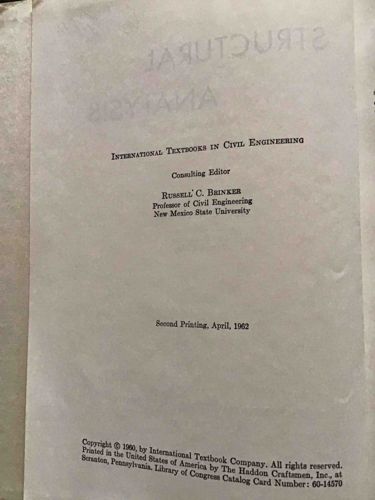
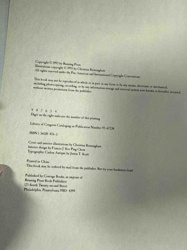
This item is identified as a vintage textbook titled "Structural Analysis," belonging to the series "International Textbooks in Civil Engineering." The visible page, likely the title or copyright page, is made of off-white paper with visible text printed in black ink. The paper appears to be of standard weight for a book of this era, possibly pulp-based given its slight discoloration, typical of older paper. The text layout is centered, neatly structured with various font sizes and weights to delineate different sections: series name, consulting editor, and publication details. The consulting editor is identified as Russell C. Brinker, Professor of Civil Engineering at New Mexico State University. Notable features include the copyright information, indicating a 1960 copyright by International Textbook Company. The book is listed as a "Second Printing, April, 1962," which dates its specific print run. It was printed in the United States of America by The Haddon Craftsmen, Inc., located in Scranton, Pennsylvania. The Library of Congress Catalog Card Number is 60-14570. The overall condition, based on the provided image, appears good, with no overt signs of significant damage such as tears, heavy creasing, or excessive foxing, which is consistent with the provided context of "Good condition." There is some very subtle discoloration around the edges of the page, or slight yellowing due to age, but it is minor. No other unique markings or owner's inscriptions are visible on this specific page. The craftsmanship suggests a standard binding quality for a textbook of its time. The 'Structural Analysis' title is partially visible in reverse at the top, hinting at the subject matter.
AI Appraisal Report
I have carefully examined the provided image of the "Structural Analysis" textbook, Second Printing, April 1962, alongside the owner's description of "Good condition." Visually, the off-white paper shows the typical slight discoloration indicative of age for a 1960s textbook, but appears free from major defects like tears, heavy creasing, or significant foxing, corroborating the stated good condition. The crispness of the black ink printing also suggests a well-preserved copy. Authenticity seems highly probable; the visible copyright details, printer information (Haddon Craftsmen, Scranton, PA), Library of Congress Catalog Card Number (60-14570), and the specific notation "Second Printing, April, 1962" align perfectly with a standard publication from that era. This is a very common type of textbook, not associated with high demand or rarity. While it holds historical interest as a document of civil engineering education from the early 1960s, it lacks unique attributes such as author signatures, significant marginalia, or exceptional binding. Market conditions for standard vintage textbooks, even in good condition, are generally stable but low. There is a niche demand from collectors of engineering ephemera or those seeking nostalgic items from their academic past, but this is limited. Comparables would be other similar academic textbooks from the period, which typically fetch modest prices. The primary factor impacting value is its commonality and the fact that it's a second printing, not a first edition. Without physical inspection, I cannot confirm the exact paper quality beyond what's visible, detect subtle odors (which might indicate mold), or examine the binding integrity and all pages for internal damage, underlining, or inscriptions. However, for a definitive appraisal of such an item, a physical examination would primarily confirm the consistency of condition throughout the entire book and assess binding robustness. For a mass-produced textbook like this, further scientific testing or provenance documentation beyond what's provided is generally unnecessary for authentication; the visible publication details are sufficiently robust.