AI Appraisal Estimate

AI-generated estimates · not official valuations

From the user

What was submitted

Photo and notes provided by the user — not generated by AI

Submitted item photo
Submitted photo · May 18, 2026

User's notes

Saracen

AI analysis below

AI appraisal

AI analysis & estimate

AI-Generated · Verify before acting

Everything below is generated by AI for informational purposes only. AI can make mistakes — the AI may misidentify items or misattribute them (artist, maker, brand, designer, origin, era). This is not an official valuation and should not be used for insurance, sale, tax, estate, legal, or lending purposes — or any decision requiring a certified appraisal. It is not an authoritative claim about any person, brand, or rights holder — do not share or rely on it as a factual statement about a third party. Always consult qualified professionals before making financial decisions.

Note

This analysis also relies on unverified notes provided by the user, which may be incomplete or inaccurate and could affect the result.

Read the full disclaimer

AI Identification

·Not independently authenticated·Verify before acting

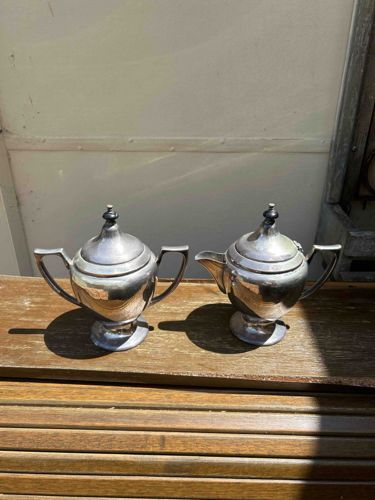
Saracen Plate Silver-Plated Teapot and Lidded Sugar Bowl Set

Antique and Vintage Silver-Plated Holloware

AI Estimated Value

·Not an official valuation·Verify before acting

$40-60

As of May 18, 2026

AI Item Analysis

·AI can make mistakes·Verify before acting
This is a two-piece matched set consisting of a small teapot and a lidded sugar bowl, crafted in 'Saracen Plate,' a trade name associated with high-quality English silver plate, often by makers such as T.H. Willmore or similar Birmingham-based silversmiths. The items feature an Art Deco influence, characterized by their sleek, globular bodies tapering down to a pedestal foot and topped with high-domed, tiered lids. Each lid is finished with a contrasting dark Bakelite or composite finial. The silver plating exhibits a soft, aged lustre with visible surface scratching and mild oxidation, particularly around the lid rims and handles, suggesting mid-20th-century origins (circa 1930s-1950s). The construction is sturdy, utilizing angular, geometric handles that align with the streamlined aesthetic of the era. The teapot features a short, gooseneck-style spout. While the plating shows signs of wear and a natural patina characteristic of regular domestic use, there are no overt dents or structural repairs visible. The underside likely bears the 'Saracen' hallmark along with an EPNS (Electroplated Nickel Silver) stamp, indicating a base metal of nickel silver. The craftsmanship is of retail-grade quality, typical of mid-century British silver plate intended for formal tea service.
AI Appraisal Report

·AI can make mistakes·Verify before acting
Based on my visual examination of this Saracen Plate teapot and lidded sugar bowl set, the items appear to be authentic examples of mid-20th-century English silver plate, likely dating to the 1930s or 1940s. The 'Saracen Plate' mark is generally associated with Birmingham manufacturers producing accessible but stylish wares. The Art Deco influence is undeniable in the tiered dome lids and distinct geometric handles, likely Bakelite or a similar composite, which adds a desirable period aesthetic. The condition, as presented, is average for domestic holloware of this vintage. I note consistent surface scratching and mild oxidation indicative of regular use and cleaning over decades. Crucially, the absence of deep dents or structural repairs helps maintain its decorative appeal, though I must highlight that silver plate holds significantly less intrinsic value than sterling silver. The market for EPNS (Electroplated Nickel Silver) is currently soft, with value driven almost entirely by aesthetics rather than metal content. Comparables for partial sets (missing a creamer or tray) generally struggle to achieve high prices. While the streamlined Deco form is collectible, the incompleteness of the service limits its potential. To provide a definitive valuation, I would need to physically inspect the plating depth to ensure the base metal (nickel silver or copper) isn't bleeding through excessively (known as 'brassing'), particularly on high-friction areas like the spout and handle joins. Without seeing the specific maker's mark clarity or weighing the items to confirm the gauge of the metal, my appraisal assumes standard retail quality. Currently, these are best valued as decorative vintage objects rather than investment-grade antiques.

Get your items appraised

Instant estimates of your treasures with AI-powered appraisals

Browse More Appraisals