AI estimate as of June 25, 2025 · verify with a professional before acting
AI-Generated · Verify before acting
Everything on this page is generated by AI for informational purposes only. AI can make mistakes — the AI may misidentify items or misattribute them (artist, maker, brand, designer, origin, era). This is not an official valuation and should not be used for insurance, sale, tax, estate, legal, or lending purposes — or any decision requiring a certified appraisal. It is not an authoritative claim about any person, brand, or rights holder — do not share or rely on it as a factual statement about a third party. Always consult qualified professionals before making financial decisions.
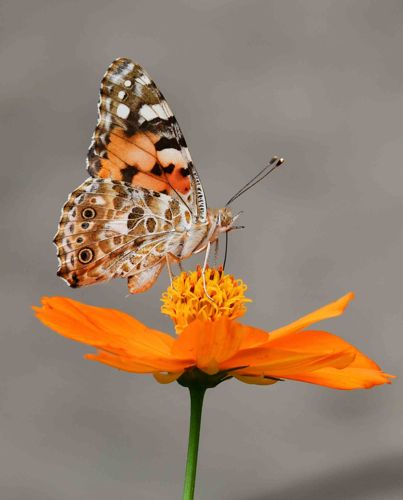
This image captures a Painted Lady butterfly (Vanessa cardui) perched delicately on the vibrant central disc of a bright orange flower, likely a Cosmos. The butterfly is presented in profile, with its wings folded upwards, revealing both the dorsal (upper) and ventral (lower) surfaces. The forewings display a striking pattern of rich orange-brown, deep black, and crisp white markings, including a prominent black patch with white spots near the wingtip. The hindwings, visible on the underside, are a mosaic of intricate camouflage patterns in shades of mottled brown, cream, and faint orange, featuring a distinct row of small, dark ocelli (eyespot-like markings) with lighter centers near the margin. The butterfly's slender, hairy body appears light brown or tan. Its two long, dark antennae, tipped with distinct clubs, extend forward. The proboscis is curled, suggesting it might have just fed or is about to feed. The insect appears to be in excellent condition with no visible tears or damage to its delicate wings. The flower, which takes up a significant portion of the lower frame, features brightly saturated orange petals arranged radially around a dense, textured central disc composed of numerous tiny yellow-orange florets. The flower's stem, visible below, is a vibrant green. The subjects are sharply in focus against a soft, uniform gray background, emphasizing the intricate details and vibrant colors of both the butterfly and the bloom. The natural craftsmanship evident in the butterfly's elaborate wing patterns and the flower's perfect bloom indicates a healthy, unblemished specimen, representative of its species' typical appearance and form.
AI Appraisal Report
Upon visual examination of the provided image, the Painted Lady butterfly (Vanessa cardui) appears to be in excellent condition. Its wings show no visible tears, nicks, or significant wear, and the intricate patterns are clear and vibrant, highly characteristic of the species. The butterfly's antennae and body also appear intact, suggesting a healthy specimen. The setting, a vibrant Cosmos flower, is also well-preserved and contributes positively to the aesthetic presentation.
However, it is crucial to note that this appraisal is based solely on a two-dimensional image. Authenticity verification, particularly for entomological specimens intended for collection or display, typically requires physical inspection. Without direct handling, I cannot definitively assess factors like the mounting method (pinning, spreading), the presence of preservatives, or signs of repair that would be evident only through tactile examination. Microscopic examination would be necessary to confirm species authenticity beyond visual appearance, though the presented features are consistent with Vanessa cardui. Provenance documentation (e.g., collection date, location, collector) is also vital for true authentication and often impacts market value.
Regarding market conditions, common butterfly species like the Painted Lady, even in excellent condition, generally do not command high values as individual specimens in the collectors' market, unless they possess unique mutations, historical significance, or are part of a professionally curated, rare collection. Comparables for common, unmounted specimens are negligible. Demand exists mainly for educational purposes or as part of larger, artistic displays. Rarity is not a factor for this species, as it is one of the most widespread butterflies globally.
Therefore, the primary value here lies in the photographic artistry rather than the intrinsic value of the butterfly as a collectible specimen. Factors that significantly impact the value of a physical specimen (e.g., provenance, preservation quality, scientific rarity) cannot be fully ascertained from the image alone. Any value ascribed to a depicted common insect specimen, especially if not preserved, is minimal.