AI estimate as of September 27, 2025 · verify with a professional before acting
AI-Generated · Verify before acting
Everything on this page is generated by AI for informational purposes only. AI can make mistakes — the AI may misidentify items or misattribute them (artist, maker, brand, designer, origin, era). This is not an official valuation and should not be used for insurance, sale, tax, estate, legal, or lending purposes — or any decision requiring a certified appraisal. It is not an authoritative claim about any person, brand, or rights holder — do not share or rely on it as a factual statement about a third party. Always consult qualified professionals before making financial decisions.
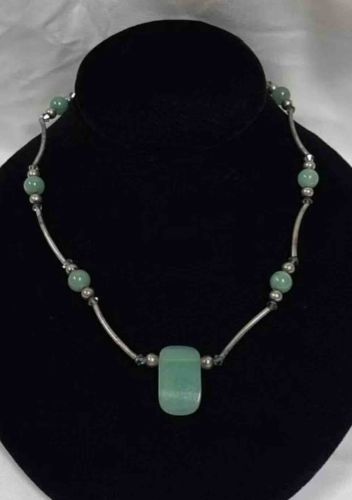
This is a vintage-style necklace featuring a combination of what appears to be jadeite or aventurine beads and silver-toned metal components. The necklace is designed with a central rectangular, elongated bead of a translucent light green hue, which is likely a form of jade or similar green gemstone, polished smooth with slightly rounded edges. Flanking this central bead are two small, faceted, dark-colored spacer beads, followed by two larger silver-toned, corrugated barrel beads, and then extending to an alternating pattern of smooth, round light green beads (matching the color tone of the central pendant, though possibly less translucent) and slender, curved, tubular silver-toned beads. Small, round, silver-toned spacer beads are interspersed throughout, creating a segmented and articulated design. The metal elements appear to be sterling silver or a silver-plated alloy, showing some signs of tarnish, which suggests age and possibly a higher silver content. The green beads exhibit natural variations in color and translucency, especially visible in the central piece, indicative of genuine stone. No visible maker's marks or stamps are discernible from the image, but the craftsmanship of the beading and stringing appears to be of good quality, suggesting a handmade or artisan-crafted piece. The style is somewhat organic and bohemian, possibly dating from the mid to late 20th century. The condition shows light wear consistent with age, primarily mild surface scratches on the beads and some tarnishing on the metal components, which could be polished. The stringing appears secure.
AI Appraisal Report
Having visually examined the image of this jade and silver bead necklace, I assess its condition as good, consistent with age. There are mild surface scratches on the beads and some tarnishing on the metal components, which is expected for such an item and can likely be polished. The stringing appears secure. Based on the translucency and color variation, the green beads are likely genuine stone, possibly jadeite or aventurine. However, without in-person inspection and specific gravity testing, I cannot definitively confirm the type of gemstone or rule out high-quality glass or another simulant. Likewise, the metal components appear to be silver-toned, and while the tarnish suggests sterling silver or a higher silver content alloy, only an acid test or XRF analysis could confirm this. There are no discernible maker’s marks, which is not uncommon for artisan or vintage pieces. Market conditions for vintage, unbranded costume or semi-precious jewelry are moderate. Comparables typically fall within a broad range depending on material authenticity and origin. Demand for green gemstone necklaces remains steady, but without a definitive identification of premium jade or a known artisan, rarity is limited. Factors impacting value significantly include the confirmed authenticity of sterling silver and genuine jadeite. If only aventurine and plated metal, the value would be at the lower end. Conversely, confirmed high-quality jadeite and sterling silver would push the value higher. A full authentication would require physical examination to verify the specific gravity and refractive index of the green beads, and meticulous testing of the metal components for silver purity. Provenance documentation would also be valuable but is often unavailable for such pieces.