AI estimate as of August 20, 2025 · verify with a professional before acting
AI-Generated · Verify before acting
Everything on this page is generated by AI for informational purposes only. AI can make mistakes — the AI may misidentify items or misattribute them (artist, maker, brand, designer, origin, era). This is not an official valuation and should not be used for insurance, sale, tax, estate, legal, or lending purposes — or any decision requiring a certified appraisal. It is not an authoritative claim about any person, brand, or rights holder — do not share or rely on it as a factual statement about a third party. Always consult qualified professionals before making financial decisions.
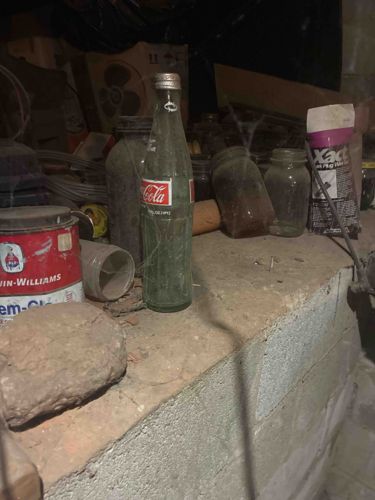
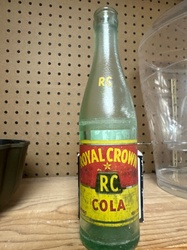
The item is a vintage Coca-Cola bottle, characterized by its clear to light greenish-tinted glass construction. It has a relatively slender profile, tapering slightly towards the top where it is capped with a silver-colored, possibly aluminum, screw-top cap. The bottle's most prominent feature is the classic red and white Coca-Cola label, which appears to be printed or molded into the glass rather than adhered. The label displays the iconic 'Coca-Cola' script logo in white against a red background, with 'TRADE-MARK REG.' and 'CONTENTS 10 FL. OZ. (296 ML)' visible below the main logo. The bottle exhibits significant dust and grime accumulation, suggesting it has been stored in a damp or neglected environment for an extended period. Cobwebs are visible on its surface, particularly along the contours. The cap also shows signs of oxidation or tarnishing. There are no visible chips, cracks, or major structural damages, but the overall condition is consistent with long-term disuse and exposure to dust. The shape of the bottle, particularly the fluted or ribbed design present below the label, suggests it is an early to mid-20th-century production, likely from the 1950s or 1960s, a period when this specific bottle design and labeling were prevalent. The fluting provides a tactile grip and is a distinctive feature of these vintage bottles. The craftsmanship appears to be standard for mass-produced glass bottles of that era, with slight imperfections in the glass typical of manufacturing processes of the time. There are no obvious maker's marks or signatures discernible from the image, apart from the Coca-Cola branding itself. The bottle is empty.
AI Appraisal Report
Upon examining the provided image of this vintage 10 fl. oz. Coca-Cola bottle, I assess its overall condition as fair to good. While the bottle itself appears free of chips, cracks, or major structural damage, the significant dust, grime, cobwebs, and tarnish on the cap indicate prolonged storage in suboptimal conditions. The integrated label, a key feature, seems intact and not worn, which is a positive. The bottle’s design, particularly the fluting and the 10 fl. oz. capacity, strongly suggests it dates from the 1950s or 1960s, a period consistent with typical Coca-Cola bottle designs of that era. Authenticity, based on visual cues, appears high; it matches known examples of vintage Coca-Cola bottles from that period. However, limitations exist – I cannot confirm the exact manufacturing date without examining mold marks, base embossing, or glass imperfections in person. Minor variations in glass thickness or color, only discernible through direct handling, could refine the dating.
Regarding market conditions, vintage Coca-Cola memorabilia, especially bottles, enjoys a steady but modest demand. Common variants, even those from the mid-20th century, are not exceedingly rare, particularly if empty. While collectors appreciate condition, the presence of dirt and tarnish, though easily cleanable, slightly diminishes its immediate appeal. Comparables for empty, unrestored 1950s-60s 10 oz. Coca-Cola bottles typically range from $8 to $25, depending on specific mold variations, glass clarity, and the presence of any unique markings. Factors significantly impacting value include the bottle's emptiness (full, sealed bottles command higher prices), the general abundance of these bottles, and the relatively common nature of this specific design. Had this bottle been a rare variant, or in mint, pristine condition with no dust or tarnish, the value would be higher. For full authentication and to narrow down the exact production period, an in-hand inspection would be necessary to examine the base and side seams for manufacturer's marks and precise mold details, which are not visible in the provided image.