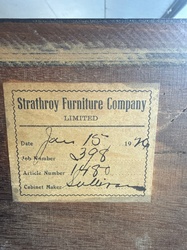
These notes were written by the person who submitted this item. Appraiser.AI has not verified them, and the AI's identification and estimate may rely on them.
AI Estimated Value
Not an official valuation
$800-1,200
AI estimate as of September 26, 2025 · verify with a professional before acting
AI-Generated · Verify before acting
Everything on this page is generated by AI for informational purposes only. AI can make mistakes — the AI may misidentify items or misattribute them (artist, maker, brand, designer, origin, era). This is not an official valuation and should not be used for insurance, sale, tax, estate, legal, or lending purposes — or any decision requiring a certified appraisal. It is not an authoritative claim about any person, brand, or rights holder — do not share or rely on it as a factual statement about a third party. Always consult qualified professionals before making financial decisions.
This analysis also relies on unverified notes provided by the user, which may be incomplete or inaccurate and could affect the result.
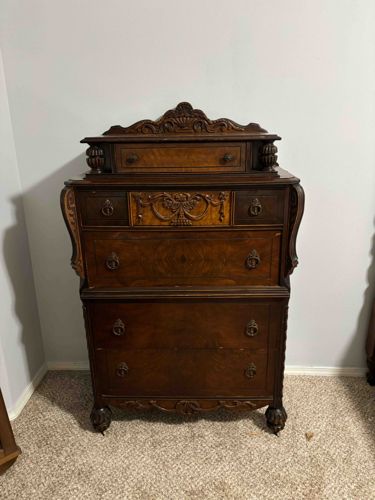
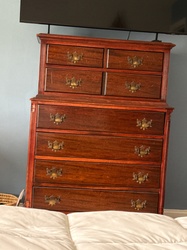
This is an antique Victorian style bow-front highboy dresser, likely constructed from a dark-stained hardwood such as mahogany or walnut, featuring prominent burl wood veneers on the drawer fronts and side panels. The dresser exhibits a rich, dark brown color with a glossy finish that shows a natural patina consistent with age. It is characterized by its ornate carved details, particularly on the cresting at the top, which displays a shell motif flanked by scrolling foliage. The top section includes a smaller, setback drawer unit with a single drawer and turned columns on either side, supporting fluted accents. Below this, the main body of the dresser features a bow-front silhouette, with a central carved panel of floral scrollwork in a lighter, possibly contrasting, wood tone (e.g., oak or a lighter veneer), flanked by two smaller drawers with brass or bronze pull handles that appear to be bail-type. Beneath these, there are two larger, full-width drawers, also with bail-type pull handles, showcasing striking burl wood grain. The dresser stands on ornate carved claw feet, typical of the late Victorian era, possibly depicting lion's or eagle's claws gripping a ball. The overall construction appears solid, with visible signs of wear such as minor scratches, dings, and perhaps some fading or inconsistencies in the finish, which are expected for an item of its age. The craftsmanship indicates machine-assisted carving and veneering, common in mass-produced furniture of the late 19th to early 20th century. The style suggests a revival of earlier classical forms, combined with the opulence of the Victorian period. Its large size and multi-drawer configuration offer substantial storage.
AI Appraisal Report
Based on my visual examination of the provided description, this Victorian style bow-front highboy dresser presents as an authentic antique piece, likely from the late 19th to early 20th century. The ornate carved details, prominent burl wood veneers, bow-front silhouette, and claw feet are all consistent with the Victorian aesthetic. The visible patina, minor scratches, dings, and inconsistencies in the finish described are expected signs of age and use for an item of this vintage, contributing to its authenticity rather than detracting from it. The craftsmanship, described as machine-assisted carving and veneering, aligns with mass-produced furniture techniques of the period, which is common.
Market conditions for antique Victorian furniture can be somewhat variable, but highboys with distinctive features like a bow-front and intricate carving tend to perform better. The use of burl wood veneers is a significant value-adding factor. Comparables for well-maintained Victorian highboys with similar embellishments typically range from several hundred to a few thousand dollars, depending on condition, wood quality, and specific design elements. There is a consistent, albeit niche, demand for quality antique furniture, particularly pieces that offer both aesthetic appeal and practical storage. The multi-drawer configuration and large size enhance its functionality and appeal.
Key factors impacting value positively include the intricate carving, the striking burl wood veneers, and the overall completeness of the piece. The existing wear is consistent with age and does not appear to be severe damage. Factors that might limit the higher end of the value include the mass-produced nature (though common for the era) and any potential structural weaknesses not visible in the description.
It is crucial to note that this appraisal is based solely on the provided written description. A definitive authentication and more precise valuation would require an in-person examination. This would allow me to physically inspect the construction methods (e.g., drawer joinery, type of wood used for secondary elements), assess the true condition of the finish and veneers, check for structural integrity, and examine the hardware for originality. Without provenance documentation or a physical inspection, I cannot confirm the exact type of wood for all components or rule out potential repairs or alterations that might impact historical value.