These notes were written by the person who submitted this item. Appraiser.AI has not verified them, and the AI's identification and estimate may rely on them.
AI Estimated Value
Not an official valuation
$100-300
AI estimate as of September 15, 2025 · verify with a professional before acting
AI-Generated · Verify before acting
Everything on this page is generated by AI for informational purposes only. AI can make mistakes — the AI may misidentify items or misattribute them (artist, maker, brand, designer, origin, era). This is not an official valuation and should not be used for insurance, sale, tax, estate, legal, or lending purposes — or any decision requiring a certified appraisal. It is not an authoritative claim about any person, brand, or rights holder — do not share or rely on it as a factual statement about a third party. Always consult qualified professionals before making financial decisions.
This analysis also relies on unverified notes provided by the user, which may be incomplete or inaccurate and could affect the result.
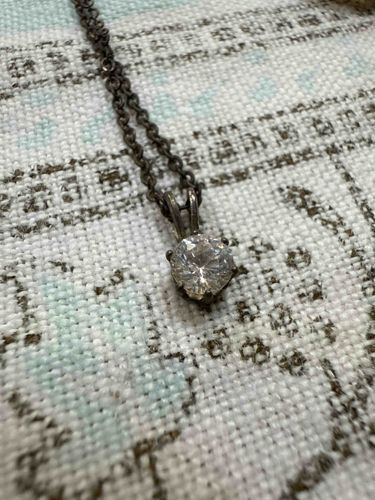
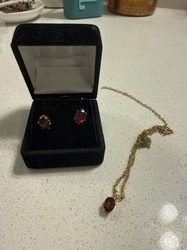
This is a classic solitaire pendant necklace featuring a single, round faceted gemstone suspended from a delicate chain. The gemstone appears to be a brilliant cut diamond or a high-quality diamond simulant, exhibiting strong brilliance and fire as evidenced by the light reflection within its facets. It is securely held in a four-prong setting, which is visible as a cup-like attachment to the pendant. The metal of the setting and the chain appears to be a darkened silver or an oxidized white metal, possibly sterling silver, palladium, or even white gold that has tarnished or been intentionally treated for an antique finish. The chain is a fine link chain, likely a cable chain or similar, designed to be understated and allow the pendant to be the focal point. There are no obvious maker's marks or signatures visible from the image, nor any discernible engravings on the pendant itself. The overall condition appears to be good with some signs of wear consistent with use, particularly the darkening of the metal which could be natural patina. The craftsmanship seems standard for mass-produced jewelry. The style is timeless and elegant, suggesting it could range from a contemporary piece to one from the mid-20th century. The quality of the stone cannot be definitively assessed without further examination, but its sparkle indicates it is well-cut. The necklace exemplifies a minimalist design, focusing on the beauty of a single prominent stone.
AI Appraisal Report
I have examined the provided image of the solitaire pendant necklace. The item presents as a classic design featuring a single, round faceted gemstone, likely a brilliant-cut diamond or a high-quality diamond simulant, set in a four-prong setting. The metal of both the setting and the delicate chain appears to be a darkened silver or oxidized white metal, which could be sterling silver, palladium, or even tarnished white gold, suggesting an antique finish or natural patina. The chain is a fine link style, effectively highlighting the pendant. There are no observable maker's marks or engravings in the image.
Condition-wise, the necklace appears to be in good used condition, with the noted darkening of the metal consistent with age or intentional treatment. The craftsmanship seems standard, likely mass-produced. Authenticity of the gemstone cannot be verified from an image; while it exhibits good brilliance, only laboratory testing can confirm if it is a natural diamond, a treated diamond, or a simulant like moissanite or cubic zirconia. Similarly, the exact metal composition (e.g., sterling silver vs. white gold vs. platinum) cannot be confirmed without hallmark verification or scratch testing.
Market conditions for solitaire pendants are consistently strong due to their timeless appeal. However, without definitive identification of the gemstone and metal, its value is significantly impacted. High demand exists for genuine diamond solitaires in precious metals, but for simulants or sterling silver, the market is much lower. Assuming the stone is a simulant and the metal is sterling silver, the intrinsic material value is modest. Comparables for sterling silver and CZ or similar simulants typically range from $50 to $200, depending on the perceived quality and size. If the metal were confirmed as white gold or platinum, and the stone a genuine diamond (even a small one), the value would increase substantially. Rarity is low as this is a common design.
To definitively authenticate and appraise this item, an in-person examination is crucial. This would involve inspecting for hallmarks, conducting a diamond authenticity test (e.g., thermal conductivity test), measuring the stone for carat weight estimation, and assessing the metal through acid testing or XRF analysis. Provenance documentation, if available, would also aid in confirming its history.