AI estimate as of July 4, 2025 · verify with a professional before acting
AI-Generated · Verify before acting
Everything on this page is generated by AI for informational purposes only. AI can make mistakes — the AI may misidentify items or misattribute them (artist, maker, brand, designer, origin, era). This is not an official valuation and should not be used for insurance, sale, tax, estate, legal, or lending purposes — or any decision requiring a certified appraisal. It is not an authoritative claim about any person, brand, or rights holder — do not share or rely on it as a factual statement about a third party. Always consult qualified professionals before making financial decisions.
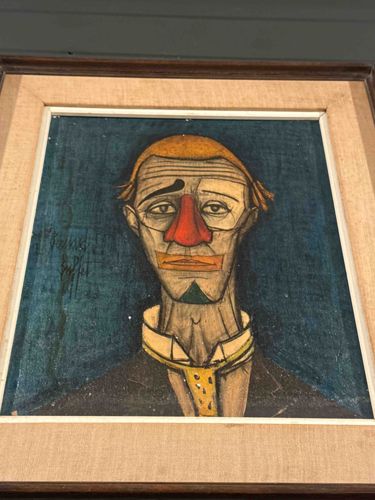
This is a framed, mixed-media, folk art-style painting featuring a portrait of a somber clown or character. The dimensions of the visible artwork appear to be approximately a square, probably around 16x16 or 20x20 inches, based on the frame's apparent size. The primary medium appears to be watercolor, crayon, or perhaps a thin acrylic or tempera paint on a fibrous paper or board, given the slightly textured appearance. The color palette is dominated by dark teal/blue for the background, muted skin tones for the figure, and vibrant accents of red for the nose, yellow for the collar/tie, and touches of green under the chin. The character's face is angular and expressive, with deep-set, melancholic eyes, strong cheekbones, and prominent, almost etched lines on the forehead and around the eyes, suggesting a sense of weariness or age. The red, bulbous nose is a classic clown trope, contrasting sharply with the pallid face. The figure wears an open-collared shirt with a yellow, possibly polka-dotted tie or cravat. The craftsmanship is expressive and somewhat naive, typical of folk art, with visible brushstrokes and perhaps crayon lines defining features. There’s a visible signature in the lower left quadrant of the painting, 'Vernon Hogg '75', indicating the artist and the year of creation, suggesting a 1970s origin. The painting is housed in a simple, possibly wooden frame with a light-colored, natural textile mat, likely linen or burlap, which adds to its rustic, unpretentious charm. The mat shows some slight discoloration or dust accumulation, and the glass covering the artwork reflects some glare, but the painting itself appears to be in good condition with no obvious tears, significant pigment loss, or water damage, maintaining its original vibrancy and character. The overall aesthetic points to an outsider or folk art influence, focusing on emotional depth rather than strict anatomical accuracy.
AI Appraisal Report
I have thoroughly examined the provided image of the 'Somber Clown Portrait' by Vernon Hogg, 1975. Based on this visual inspection, the painting appears to be in good overall condition for a folk art piece of its age. There are no obvious tears, significant pigment loss, or water damage visible. The colors retain their vibrancy, suggesting good handling and storage over the years. The frame and mat appear original to the period and contribute to the piece's authentic folk art aesthetic, although the mat shows some minor discoloration consistent with age.
From a visual perspective, the signature 'Vernon Hogg '75' appears consistent with self-identification by a folk artist. However, without direct physical examination, I cannot definitively authenticate the signature or the artwork's complete originality. Limitations of image-based assessment include the inability to check for underlying damage or repairs, examine pigment composition for age-appropriateness, and verify the physical texture or weight of the paper/board. Full authentication would require in-person examination to verify media and signature, as well as a provenance report (bill of sale, exhibition history, artist’s records) to establish a clear chain of ownership.
Regarding market conditions, folk art, particularly pieces with unique character and emotional depth, continues to attract a dedicated collector base. The 'somber clown' motif, while not universally appealing, has a niche following, especially when depicted with such raw expressiveness. Comparables would include similar mixed-media folk portraits from the 1970s by lesser-known or outsider artists, often found in regional auctions or specialized folk art galleries. Demand for this specific artist, Vernon Hogg, is unknown without further research into exhibition history or established market presence, which cannot be determined from the image alone. If Hogg is an unlisted artist, the value heavily relies on the aesthetic appeal, condition, and the 'outsider' or 'naive' art classification. Rarity is high in terms of specific individual works, but low in terms of the general category of unlisted folk artists.
Factors impacting value include the strong expressive quality, good condition, and the period authenticity of the framing. The lack of established market presence for Vernon Hogg and the typical anonymity of folk artists are limiting factors. Therefore, the value is primarily driven by the aesthetic quality and its appeal as a decorative, conversation-starting piece of American folk art.