AI Appraisal Estimate

AI-generated estimates · not official valuations

From the user

What was submitted

Photo and notes provided by the user — not generated by AI

Submitted item photo
Submitted photo · June 22, 2026

User's notes

No additional notes provided.

AI analysis below

AI appraisal

AI analysis & estimate

AI-Generated · Verify before acting

Everything below is generated by AI for informational purposes only. AI can make mistakes — the AI may misidentify items or misattribute them (artist, maker, brand, designer, origin, era). This is not an official valuation and should not be used for insurance, sale, tax, estate, legal, or lending purposes — or any decision requiring a certified appraisal. It is not an authoritative claim about any person, brand, or rights holder — do not share or rely on it as a factual statement about a third party. Always consult qualified professionals before making financial decisions.

Read the full disclaimer

AI Identification

·Not independently authenticated·Verify before acting

Vintage Celluloid or Early Plastic Floral Brooches

Vintage Costume Jewelry

AI Estimated Value

·Not an official valuation·Verify before acting

$45 - $75

As of June 22, 2026

AI Item Analysis

·AI can make mistakes·Verify before acting
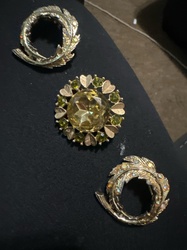
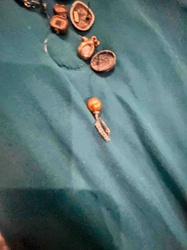
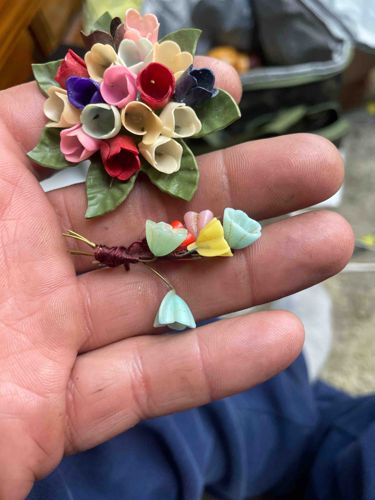
This set consists of two vintage costume jewelry brooches featuring miniature floral arrangements. The larger brooch is a dense, circular bouquet measuring approximately 2 inches in diameter, composed of numerous bell-shaped flowers in a vibrant palette including crimson red, royal purple, dusty pink, cream, and navy blue. These flowers are set against a backdrop of deep green serrated leaves. The second, smaller piece is a linear spray brooch featuring delicate pastel-toned flowers in shades of mint green, pale yellow, and soft pink, with one flower suspended on a wire to create movement. Both items appear to be constructed from early plastics, likely celluloid or a similar moldable resin, which was common in the mid-20th century (1930s-1950s). The flowers are attached to thin wire stems, with the smaller brooch showcasing visible wire wrapping at the base finished with a dark maroon thread or tape. Regarding condition, the pieces show aged patina with some accumulation of dust in the crevices of the petal cups. There is a visible fracture or loss on the pale mint flower of the smaller brooch, and the wire stems show some slight bending. The craftsmanship is typical of high-quality mass-produced novelty jewelry from the period, utilizing hand-assembly of molded components to create a realistic three-dimensional effect. No maker's marks are immediately visible, which is common for these types of botanical whimsies.
AI Appraisal Report

·AI can make mistakes·Verify before acting
Based on my visual examination of these two vintage floral brooches, I identify them as characteristic examples of early plastic costume jewelry, likely dating to the 1930s or 1940s. The material appears consistent with celluloid or early cellulose acetate, distinguished by the thin, molded quality of the petals and the vivid, matte coloration. The larger circular brooch is particularly striking due to its dense composition and rich jewel-tone palette of crimson, royal purple, and deep green. This density of 'bloom' is desirable in the current market. However, condition is a significant limiting factor for this set. While the larger piece retains good structural integrity, I noted surface dust accumulation that will require careful cleaning. The smaller linear spray, while charming, suffers from a visible fracture on the pale mint flower and misshapen wire stems. Such damage to brittle early plastics is difficult to repair invisibly and lowers the value considerably compared to mint-condition examples. The market for early plastic 'novelty' jewelry remains steady but niche. Collectors prize intricate assembly and vibrant colors, both present here, but are highly sensitive to damage. Similar high-quality celluloid bouquets generally retail between $40 and $80 individually, but the damage to the smaller piece regulates this lot to the lower end of that spectrum as a 'beater' or repair lot item accompanying the main piece. This appraisal is limited by the lack of physical inspection. To confirm the material definitively as celluloid rather than a later thermoset plastic, I would need to perform a scent test (camphor smell under hot water) or a careful visual inspection of the pin findings, which often provide clues to the precise decade of manufacture.

Get your items appraised

Instant estimates of your treasures with AI-powered appraisals

Browse More Appraisals