These notes were written by the person who submitted this item. Appraiser.AI has not verified them, and the AI's identification and estimate may rely on them.
AI Estimated Value
Not an official valuation
$30-50
AI estimate as of August 13, 2025 · verify with a professional before acting
AI-Generated · Verify before acting
Everything on this page is generated by AI for informational purposes only. AI can make mistakes — the AI may misidentify items or misattribute them (artist, maker, brand, designer, origin, era). This is not an official valuation and should not be used for insurance, sale, tax, estate, legal, or lending purposes — or any decision requiring a certified appraisal. It is not an authoritative claim about any person, brand, or rights holder — do not share or rely on it as a factual statement about a third party. Always consult qualified professionals before making financial decisions.
This analysis also relies on unverified notes provided by the user, which may be incomplete or inaccurate and could affect the result.
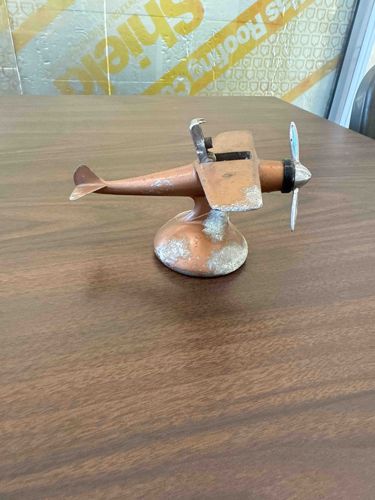
This item is a novelty table lighter designed to resemble a biplane or monoplane, likely cast from a metal alloy such as pot metal, given the appearance of an aged, somewhat flaky metallic coating and the material's common use in die-cast objects of this type. The primary color of the item appears to be a faded or tarnished copper or bronze tone, a common finish for die-cast pieces to emulate more valuable metals. The base of the lighter is integrated into the airplane's design, forming a stable, rounded platform from which the fuselage extends. The wings are flat and rectangular, with a slightly textured or pitted surface, suggesting either age-related wear or a characteristic of the casting process. The propeller at the front of the aircraft is a distinct, lighter-colored element, possibly silver-toned or polished metal. The critical feature, the lighter mechanism, is positioned on top of the fuselage, just behind the cockpit area. It includes the characteristic flint wheel and wick assembly, which shows significant signs of use and wear, including discoloration and what appears to be residue from flint dust or old fuel. The overall condition indicates significant patina and surface degradation, with areas of the original finish worn away, revealing a duller, possibly corroded metallic underlayer. There is no visible maker's mark or signature in the provided image, making specific manufacturing details difficult to ascertain. Based on its style and common production periods for such novelty items, it likely dates from the mid-20th century, possibly the 1930s-1950s, a period when novelty lighters were popular. The craftsmanship, while appearing mass-produced due to the die-cast nature, shows an effort to create a detailed and functional decorative piece, characteristic of items designed for both utility and display.
AI Appraisal Report
Upon examining the images of this Die-Cast Airplane Novelty Table Lighter, I assess it to be a mass-produced tobacciana item, likely dating from the mid-20th century (c. 1930s-1950s). The piece presents in 'fair' condition, showing significant signs of age and use. The die-cast pot metal body exhibits extensive patina, surface degradation, and finish loss, which is common for items of this material and age. The lighter mechanism appears worn, consistent with its intended function.
The market for such novelty lighters is fairly stable, with collectors often seeking unique designs. While this airplane form is appealing, similar 'Diecasters' or unbranded biplane and monoplane lighters are relatively common. Recent sales of comparable items in similar condition typically range from $25 to $60. The value is significantly impacted by the lack of a discernible maker's mark (such as Ronson, Zippo, or Dunhill), which would elevate its desirability. Its current condition, while demonstrating authenticity in its age, detracts from its value compared to examples with intact plating and a fully functional mechanism.
It is important to note that this appraisal is based solely on images. An in-person examination would be required to confirm the material composition, test the functionality of the lighter mechanism, and search for any faint maker's marks not visible in the photographs. Without physical inspection, a definitive authentication or attribution to a specific manufacturer cannot be made, limiting the current valuation.