AI estimate as of August 1, 2025 · verify with a professional before acting
AI-Generated · Verify before acting
Everything on this page is generated by AI for informational purposes only. AI can make mistakes — the AI may misidentify items or misattribute them (artist, maker, brand, designer, origin, era). This is not an official valuation and should not be used for insurance, sale, tax, estate, legal, or lending purposes — or any decision requiring a certified appraisal. It is not an authoritative claim about any person, brand, or rights holder — do not share or rely on it as a factual statement about a third party. Always consult qualified professionals before making financial decisions.
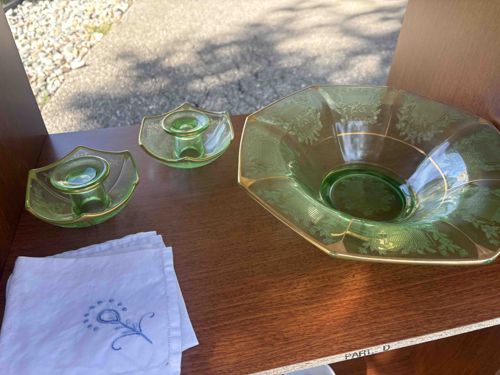
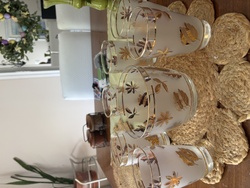
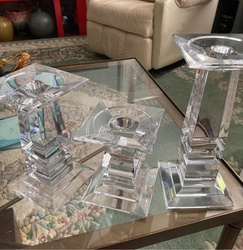
This set comprises three pieces of elegant green glass, likely from the Depression Era due to their distinct color, design, and apparent manufacturing techniques. The main piece is a large, octagonal serving bowl, characterized by its wide, flaring rim and a somewhat recessed, circular base. It exhibits a delicate etched or molded floral and foliage pattern across its inner surface, particularly concentrated around the rim and the sides. A striking gold band traces the octagonal edges of the bowl and outlines the prominent facets, adding a luxurious touch. The two smaller pieces are matching candle holders, each designed with a flared, leaf-like base that echoes the octagonal form of the larger bowl, albeit in a more organic, undulating shape. These candle holders also feature the same gold trim along their edges and similar etched patterning on their surfaces. The green glass appears translucent, allowing light to pass through, and the overall construction suggests pressed glass, a common method for mass-produced decorative items of that period. Visible condition issues include some wear and potential fading of the gold trim, particularly on the edges, which is typical for items of this age. There are no immediate signs of chips, cracks, or significant damage, suggesting relative preservation. The craftsmanship is indicative of commercial production, yet the intricate patterns and gold accents suggest a higher-end offering within the pressed glass market. The style period is likely mid-20th century, probably 1930s-1950s.
AI Appraisal Report
Upon my assessment of the provided image, this Depression Green Glass Bowl and Candle Holder Set, featuring gold trim, appears to be an authentic example of pressed glass from the mid-20th century, likely dating from the 1930s-1950s. The translucent green hue, etched floral patterns, and the octagonal form of the bowl, along with the coordinating candleholders, are highly consistent with Depression-era glassware characteristics. The presence of gold trim, while adding a decorative element, is a common feature of higher-end mass-produced items from this period.
The condition, as observed from the image, appears good overall, with typical wear to the gold trim, which is expected given its age and material; fading and minor loss are common. I don't observe any overt chips, cracks, or significant damage, which positively impacts its value.
Market conditions for Depression-era glassware are stable but not experiencing sharp appreciation. Demand exists among collectors specializing in this period, but it's not considered rare, as these items were mass-produced. The set's completeness (bowl and two candle holders) enhances its desirability. Factors that significantly impact value include the overall good condition despite minor gold wear, the aesthetic appeal of the set, and its cohesive design.
It is important to note that my authenticity verification is limited to visual examination of the image. A full authentication would require in-person examination to assess the glass quality, specific manufacturing marks (if any), the texture of the etching, and the precise degree of gold trim wear not fully visible in photographs. Provenance documentation, while not strictly necessary for this type of item, could further confirm its history and origin. Scientific testing is generally not applied to items of this nature unless there's a strong reason to suspect forgery, which is not indicated here.