AI estimate as of October 28, 2025 · verify with a professional before acting
AI-Generated · Verify before acting
Everything on this page is generated by AI for informational purposes only. AI can make mistakes — the AI may misidentify items or misattribute them (artist, maker, brand, designer, origin, era). This is not an official valuation and should not be used for insurance, sale, tax, estate, legal, or lending purposes — or any decision requiring a certified appraisal. It is not an authoritative claim about any person, brand, or rights holder — do not share or rely on it as a factual statement about a third party. Always consult qualified professionals before making financial decisions.
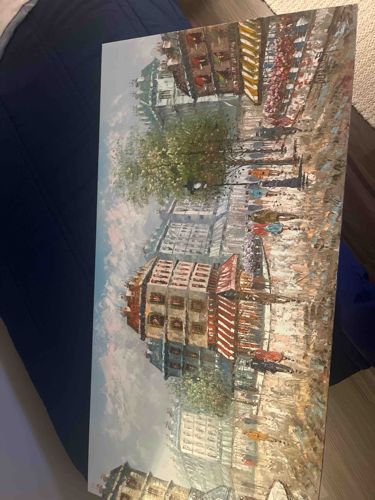
This item is an oil painting on canvas depicting a bustling European cityscape, rendered in an impressionistic style. The artwork features a vibrant street scene with multi-story buildings, some with striped awnings in yellow and white or red. Lush green trees, possibly in bloom with white or light-colored foliage, are visible along what appears to be a boulevard or main thoroughfare. Figures of people, rendered abstractly with broad, visible brushstrokes, populate the sidewalks and streets, suggesting movement and activity. A streetlamp is also discernible. The color palette is rich and textured, dominated by earthy browns, reds, blues, grays, and greens, with lighter tones for the sky and some architectural details. The painting exhibits a heavy impasto technique, where oil paint is applied thickly, creating a three-dimensional texture that is visually apparent and tactile. This technique, common in Impressionist and Post-Impressionist works, adds depth and dynamism to the scene. The canvas appears to be stretched and framed, consistent with a ready-to-display artwork. No significant condition issues like tears, punctures, or extreme discoloration are immediately visible from the provided image, though a closer inspection would be required to ascertain minor wear or surface grime. The style suggests it could be from the mid-20th century to contemporary, likely a decorative piece rather than an antique masterwork, given the typical production of such scenes for the general art market. The craftsmanship, while employing a skilled technique, aims for atmospheric effect over meticulous detail, making it a qualitative example of its style.
AI Appraisal Report
Based on my visual examination of the provided image, this Impressionistic European Cityscape Oil Painting on Canvas presents as a well-executed decorative piece. The condition appears good, with no obvious tears, punctures, or significant discoloration visible, suggesting it's ready for display. The heavy impasto technique is a notable characteristic, adding tactile depth and aligning with the impressionistic style, which is appealing to many buyers. The rich color palette and dynamic street scene contribute to its aesthetic value.
Authenticity, solely from an image, is limited. While the style and execution are consistent with fine art produced from the mid-20th century to contemporary, determining the artist, origin, or specific age beyond this range would require in-person examination. Factors impacting value include the lack of a discernible signature, which would significantly increase its marketability if attributed to a recognized artist. Without provenance documentation, it is challenging to verify its history or specific maker.
Market conditions for such decorative impressionistic cityscapes are generally stable. Comparable works by unlisted artists in this style typically sell in the $300-$800 range, depending on size, framing quality, and overall aesthetic appeal. Demand exists for pieces that offer strong visual interest and complement various interior designs. This piece, with its appealing composition and technique, falls squarely into that category. Rarity is low as similar works are widely produced.
For full authentication and a more precise valuation, a physical inspection would be crucial to examine the canvas, stretcher, paint layers, and any potential signature or inscriptions on the verso. Scientific testing, such as pigment analysis or UV light examination, could confirm age and materials, but is typically reserved for works with higher potential value or attribution questions. Without such physical inspection and provenance, this appraisal is based purely on the visual characteristics and general market trends for such a genre.