AI Appraisal Estimate

AI-generated estimates · not official valuations

From the user

What was submitted

Photo and notes provided by the user — not generated by AI

Submitted item photo
Submitted photo · June 8, 2026

User's notes

No additional notes provided.

AI analysis below

AI appraisal

AI analysis & estimate

AI-Generated · Verify before acting

Everything below is generated by AI for informational purposes only. AI can make mistakes — the AI may misidentify items or misattribute them (artist, maker, brand, designer, origin, era). This is not an official valuation and should not be used for insurance, sale, tax, estate, legal, or lending purposes — or any decision requiring a certified appraisal. It is not an authoritative claim about any person, brand, or rights holder — do not share or rely on it as a factual statement about a third party. Always consult qualified professionals before making financial decisions.

Read the full disclaimer

AI Identification

·Not independently authenticated·Verify before acting

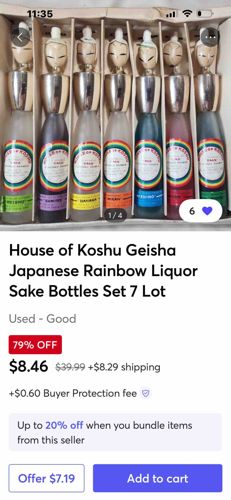
Vintage House of Koshu Geisha Rainbow Sake Bottle Set

Vintage Barware & Collectible Bottles

AI Estimated Value

·Not an official valuation·Verify before acting

$150-$250

As of June 8, 2026

AI Item Analysis

·AI can make mistakes·Verify before acting
This is a vintage boxed collection of seven 'House of Koshu' sake or liquor bottles, designed in a novelty mid-century style. Each glass bottle is slender and tapered, featuring a unique decorative topper shaped like a stylized Geisha head. The toppers are crafted from a cream-colored material, possibly plastic or celluloid, with hand-painted facial features and distinctive hair buns. Below the heads are metallic-finish collars in a silver-toned chrome, which serve as the bottle caps. The set is notable for its 'rainbow' theme, where each bottle contains a differently colored liquid—typically fruit-infused sake or cordials—paired with color-coded labels at the base in shades of green, purple, yellow, orange, blue, red, and dark green. Each bottle carries a white circular label with a rainbow border and the brand name 'House of Koshu.' Circa 1960s to 1970s, these sets were popular Japanese export items. The condition appears to be used-good; while the bottles are housed in their original cardboard dividers, there is visible condensation or cloudiness in some glass, and the outer packaging shows shelf wear and minor crushing. The liquid levels vary, suggesting possible evaporation or previous opening. Craftsmanship is typical of mass-produced novelty barware of the era, focusing on vibrant visual appeal and cultural kitsch.
AI Appraisal Report

·AI can make mistakes·Verify before acting
I have conducted a visual examination of the Vintage House of Koshu 'Rainbow' Sake Set. This specific seven-bottle configuration, produced during the 1960s/70s export boom, represents a classic example of Mid-Century Japanese kitsch barware. The set retains its original toppers and labeled bottles, which is critical for value. However, several condition issues negatively impact the appraisal. Visible cloudiness in the glass suggests mineral deposits or residue, and disparate liquid levels indicate significant evaporation or compromised seals. The original box, while present, shows structural degradation and shelf wear. Market demand for House of Koshu items remains steady among tiki bar enthusiasts and Japaneseiana collectors. Comparable sets in pristine, unopened condition with clear glass have reached $350, whereas incomplete or damaged sets often fall below $100. This set sits in the mid-range due to its completeness and the presence of the original display box. Authenticity is supported by the specific molding of the Geisha heads and the typography on the 'House of Koshu' labels. Limitations: This appraisal is based solely on digital imagery. A physical inspection is required to determine if the cloudy glass is 'sick glass' (irreversible chemical degradation) or merely surface residue. I cannot verify if the original seals are intact or if the contents have been replaced. Full authentication would require testing the liquid's alcohol content against period specifications and a tactile examination of the toppers to distinguish between early celluloid and later injection-molded plastics.

Get your items appraised

Instant estimates of your treasures with AI-powered appraisals

Browse More Appraisals