AI Appraisal Estimate

AI-generated estimates · not official valuations

From the user

What was submitted

Photo and notes provided by the user — not generated by AI

Submitted item photo
Submitted photo · June 22, 2026

User's notes

Unknown artist, untitled pottery

AI analysis below

AI appraisal

AI analysis & estimate

AI-Generated · Verify before acting

Everything below is generated by AI for informational purposes only. AI can make mistakes — the AI may misidentify items or misattribute them (artist, maker, brand, designer, origin, era). This is not an official valuation and should not be used for insurance, sale, tax, estate, legal, or lending purposes — or any decision requiring a certified appraisal. It is not an authoritative claim about any person, brand, or rights holder — do not share or rely on it as a factual statement about a third party. Always consult qualified professionals before making financial decisions.

Note

This analysis also relies on unverified notes provided by the user, which may be incomplete or inaccurate and could affect the result.

Read the full disclaimer

AI Identification

·Not independently authenticated·Verify before acting

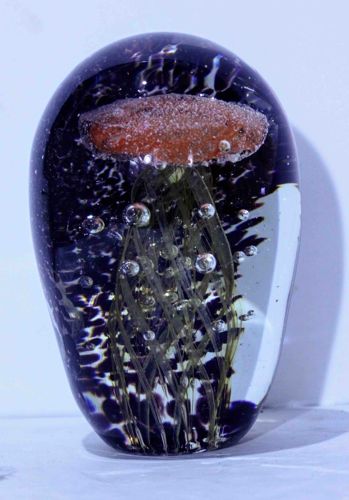
Jellyfish Art Glass Paperweight

Art Glass / Collectibles

AI Estimated Value

·Not an official valuation·Verify before acting

$40 - $70

As of June 22, 2026

AI Item Analysis

·AI can make mistakes·Verify before acting
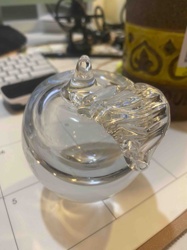
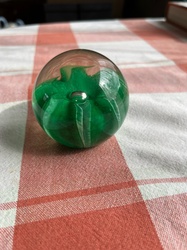
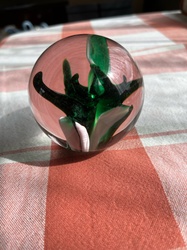
This is a hand-blown glass paperweight featuring an inner lampwork or frit-worked jellyfish motif suspended in clear solid glass. The object is ovoid or egg-shaped with a slightly flattened base for stability. The 'jellyfish' features a textured, reddish-orange cap with an iridescent, granular surface finish, suggesting the use of coarse glass frit. Below the cap, translucent pale-greenish-to-yellow filaments arc downward to represent tentacles. Intentionally placed controlled bubbles (bullicante) surround the jellyfish, simulating rising oxygen and enhancing the underwater aesthetic. The surround consists of dark indigo or deep purple 'ink' swirls at the top and base, which create a sense of depth against the clear central portion. The glass exhibits high clarity with no visible surface scratches, chips, or clouding in the provided image. The bottom likely features a polished pontil mark, common in high-quality handmade glass from the late 20th to early 21st century. While the artist is unidentified, the craftsmanship suggests a skilled artisan familiar with contemporary glassblowing techniques used in paperweight production.
AI Appraisal Report

·AI can make mistakes·Verify before acting
Based on my visual examination of this hand-blown art glass paperweight, the piece appears to be in excellent condition, exhibiting high clarity free of scratches, chips, or internal hazing. The craftsmanship is competent, demonstrating key techniques like controlled bubble placement (bullicante) and the layering of frit and lampwork to create the convincing jellyfish anatomy. The reddish-orange cap with its iridescent, granular texture is executed well, providing a visually striking contrast against the deep indigo swirls that frame the piece. This specific style of jellyfish paperweight has been popularly produced by various studios ranging from prominent makers like Satava or Dynasty Gallery to broadly distributed imports from China (often referred to as 'Glow-in-the-Dark' series, as some contain phosphorescent powders). Without a signature, sticker, or specific provenance, it is difficult to attribute this to a high-value studio artist like Richard Satava (whose works often fetch $300-$1,000+). The execution, while beautiful, strongly resembles the mass-market or mid-tier art glass widely available in museum gift shops and galleries during the early 2000s to present. Value is driven primarily by decorative appeal rather than investment rarity. Similar unsigned jellyfish paperweights consistently sell in the $40 to $70 range on secondary markets like eBay or Etsy. To determine if this possesses higher value, an in-person inspection is critical to locate faint acid-etched signatures on the base or to feel the weight and density of the glass, which can distinguish studio crystal from standard soda-lime glass.

Get your items appraised

Instant estimates of your treasures with AI-powered appraisals

Browse More Appraisals