AI estimate as of July 19, 2025 · verify with a professional before acting
AI-Generated · Verify before acting
Everything on this page is generated by AI for informational purposes only. AI can make mistakes — the AI may misidentify items or misattribute them (artist, maker, brand, designer, origin, era). This is not an official valuation and should not be used for insurance, sale, tax, estate, legal, or lending purposes — or any decision requiring a certified appraisal. It is not an authoritative claim about any person, brand, or rights holder — do not share or rely on it as a factual statement about a third party. Always consult qualified professionals before making financial decisions.
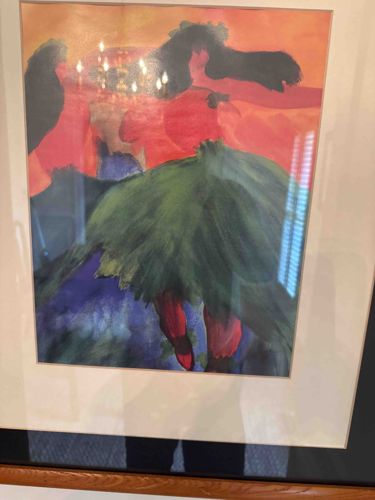
The item is a framed art print, likely a lithograph or giclée, featuring an abstract or semi-abstract composition with vibrant colors. The dominant colors in the artwork itself are rich reds, deep greens, and varying shades of blue and purple, along with stark black forms and an orange-yellow background. The brushstrokes appear fluid and expressive, suggesting a painterly technique. The composition features what appears to be a large, sweeping green form in the foreground, possibly representing a skirt or a landscape element. Above it, red and black shapes are visible, perhaps abstract figures or additional landscape features. A notable feature is the reflection of a multi-light chandelier or ceiling fixture in the glass, suggesting that the print is displayed under ambient indoor lighting. The print is matted with a wide, off-white or cream-colored mat board, which is clean and free of visible stains or discoloration. The frame is a dark, possibly black, inner frame with an outer wooden frame in a natural or light brown finish. The wooden frame shows a clear grain, indicating solid wood construction. The overall condition appears good, with no obvious signs of damage, fading, or wear to the print itself or the mat. The glass covering the print is somewhat reflective, but no scratches or cracks are discernible. Without visible signatures or specific marks, the manufacturing details and exact period are difficult to ascertain, but the style suggests a mid-to-late 20th century or contemporary artistic approach. The craftsmanship of the framing appears professional, with clean lines and consistent matting.
AI Appraisal Report
Based on my examination of the image of this framed abstract figure art print, I assess its condition as good. The print itself appears vibrant, with no visible fading, tears, or discoloration. The mat board is clean and well-cut, and the frame seems structurally sound with clean lines. The reflection of the chandelier suggests a glass covering, which appears intact without discernible scratches or cracks.
Authenticity is difficult to determine from an image alone. While the style suggests a mid-to-late 20th century or contemporary abstract work, without a visible signature, edition number, or artist's mark, confirming its authenticity as an original print by a known artist is impossible. It could be a decorative print rather than a fine art limited edition.
Market conditions for abstract prints vary widely. If this is a decorative print, its value is largely tied to its aesthetic appeal and the quality of its framing. If it's a signed, limited-edition print by a recognized artist, the value would be significantly higher. Given the lack of identifying marks, comparables would lean towards quality framed decorative art prints rather than authenticated fine art prints. Demand for abstract art remains steady, but rarity is unknown without provenance.
Factors significantly impacting value include the artist's identity (or lack thereof), whether it's a limited edition, the print process (lithograph vs. giclée), and its exact date. Without these details, its value is primarily as a well-framed decorative piece.
For full authentication, an in-person examination is crucial to inspect the print medium, assess the texture, look for watermarks or blind stamps, and examine the reverse for any labels or inscriptions. Provenance documentation (e.g., certificate of authenticity, purchase receipts) and scientific testing (e.g., pigment analysis) would also be needed to confirm the artist and print type.