AI estimate as of October 10, 2025 · verify with a professional before acting
AI-Generated · Verify before acting
Everything on this page is generated by AI for informational purposes only. AI can make mistakes — the AI may misidentify items or misattribute them (artist, maker, brand, designer, origin, era). This is not an official valuation and should not be used for insurance, sale, tax, estate, legal, or lending purposes — or any decision requiring a certified appraisal. It is not an authoritative claim about any person, brand, or rights holder — do not share or rely on it as a factual statement about a third party. Always consult qualified professionals before making financial decisions.
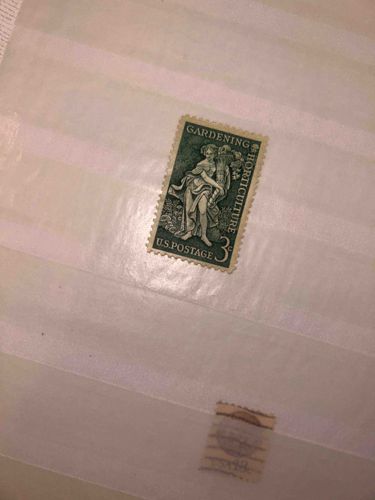
This item is a United States postage stamp, denominated at 3 cents. The stamp features a central vignette depicting a classical female figure, likely a representation of Pomona or a similar allegorical figure associated with agriculture and abundance. She is shown in flowing drapery, with her left arm cradling a cornucopia overflowing with fruits, implying prosperity and harvest. The color of the stamp's imprint is a deep forest green, and it is printed on what appears to be standard stamp paper, likely off-white or cream in its natural color, though it is slightly discolored in the specific example. The design is framed by a thin border. 'GARDENING' is printed horizontally across the top left corner, and 'HORTICULTURE' is printed vertically along the right side, both in a clear sans-serif font. 'U.S. POSTAGE' is printed horizontally along the bottom left edge, and the denomination '3¢' is visible in the bottom right corner. The stamp exhibits perforation along all four edges, indicating it was separated from a sheet. There are visible signs of wear and age on this particular stamp. The paper appears slightly toned or yellowed, and there's a visible stain or discoloration in the upper right portion of the central image. The perforations appear intact, though some might be softly rounded at the tips due to handling. The impression itself shows good detail, suggesting decent printing quality for its era. The style of the illustration and typography aligns with mid-20th-century philately, specifically pointing to the late 1950s.
AI Appraisal Report
I have carefully examined the provided image of this U.S. Postage 3 Cent 'Gardening Horticulture' Stamp (1958). Based on visual inspection, the stamp appears authentic for its type, displaying the correct design elements, typography, and perforation style consistent with the 1958 issue (Scott #1105). The deep forest green ink and allegorical figure holding a cornucopia are characteristic. However, its condition is a significant factor in valuation. The paper shows clear toning/yellowing, indicating age or environmental exposure. More noticeably, there is a visible stain or discoloration in the upper right quadrant of the central image, which significantly detracts from its aesthetic appeal and collectible grade. While the perforations appear largely intact, some softening at the tips is evident, consistent with handling. This particular issue is extremely common, with millions printed, which depresses its market value considerably. Unused, very fine condition examples typically sell for minimal amounts, usually under a dollar. Used copies, particularly those with significant faults like staining and toning, are commonly found in mixtures or bulk lots and hold very little individual collector value. The demand for this specific stamp is low among serious collectors, who prioritize pristine condition. Without physical examination, I cannot definitively assess paper thickness, gum condition (if unused), or microscopic printing anomalies that might indicate counterfeiting, though such efforts are rare for stamps of this low value. The primary authenticity verification required would be an in-person inspection to confirm paper type, gum, and absence of repairs, and to rule out any potential, albeit unlikely, forgeries.