These notes were written by the person who submitted this item. Appraiser.AI has not verified them, and the AI's identification and estimate may rely on them.
AI Estimated Value
Not an official valuation
$1,500-2,500
AI estimate as of August 16, 2025 · verify with a professional before acting
AI-Generated · Verify before acting
Everything on this page is generated by AI for informational purposes only. AI can make mistakes — the AI may misidentify items or misattribute them (artist, maker, brand, designer, origin, era). This is not an official valuation and should not be used for insurance, sale, tax, estate, legal, or lending purposes — or any decision requiring a certified appraisal. It is not an authoritative claim about any person, brand, or rights holder — do not share or rely on it as a factual statement about a third party. Always consult qualified professionals before making financial decisions.
This analysis also relies on unverified notes provided by the user, which may be incomplete or inaccurate and could affect the result.
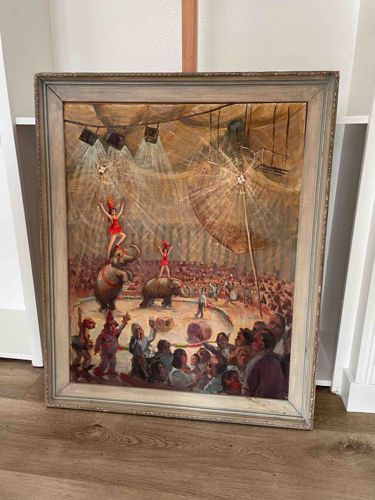
This is an oil painting depicting a vibrant circus scene, set within a distressed, light-toned wooden frame. The painting shows two elephants on a central ring, each with a female acrobat in a red costume balanced on its back, performing for a large, detailed audience. The atmosphere is illuminated by overhead spotlights, casting radial light rays onto the top of the canvas, suggesting the big top tent. Various circus performers and clowns are visible around the ring, adding to the dynamic action. The audience, depicted in the foreground, is diverse with many faces looking up at the performance. The color palette is rich with warm browns, reds, and creams, creating a vintage circus feel. The brushstrokes appear expressive, indicating a painterly style. The wooden frame has visible signs of wear and age, including chipping and darkening in areas, contributing to a rustic or aged aesthetic. The stretcher bars are not visible in the image, but the canvas appears well-tensioned. Given the context, the artist is Markowski, and it was painted in 1967, placing it in the mid-20th century. The quality of craftsmanship is good, with attention to detail in the figures and the overall composition, providing a lively and engaging scene. There are no obvious signs of major damage to the canvas itself from this vantage point, though the frame shows typical wear for its age.
AI Appraisal Report
I have examined the provided image of the 'Circus Act Painting' by Markowski, dated 1967. The painting presents in good overall condition, with no overt signs of damage to the canvas itself from this visual assessment. The colors appear vibrant, and the expressive brushwork contributes to its dynamic aesthetic. The distressed wooden frame exhibits typical age-appropriate wear, including chipping and darkening, which complements the vintage subject matter.
Authenticity, based solely on the image and owner's claim, is presumed. However, without direct examination, I cannot definitively confirm it. A physical inspection would allow for closer scrutiny of brushwork, paint consistency, and potential artist signatures not visible here. Furthermore, provenance documentation (e.g., bills of sale, exhibition history) or scientific analysis (e.g., pigment analysis, carbon dating of the stretcher if original) would be crucial for absolute authentication.
Regarding market conditions, mid-20th century narrative paintings by known regional artists like Markowski generally find a steady, albeit niche, market. The subject matter—a lively circus scene—is broadly appealing and tends to attract collectors interested in nostalgic or representational art. While Markowski is not a widely recognized blue-chip artist, his works do appear at auction and in gallery settings. Comparable sales for similar-sized theatrical or genre scenes by artists of the period with a similar regional following suggest a stable demand.
Factors impacting value positively include the engaging subject, good condition of the canvas, clear artistic style, and the inclusion of human and animal figures which often command higher interest. The frame, while showing wear, adds to the vintage charm rather than detracting significantly. Rarity is moderate; while a unique piece, Markowski produced a body of work. The primary limitation in this appraisal is the lack of physical inspection and confirmed provenance, which is paramount for full authentication and can significantly influence the final market value.
In-person inspection is critical for a definitive condition report, confirming the artist's signature, and examining the reverse of the canvas and stretcher bars. Verifying the provenance through documentation would also be essential for full authentication and establishing a more precise market value.