These notes were written by the person who submitted this item. Appraiser.AI has not verified them, and the AI's identification and estimate may rely on them.
AI Estimated Value
Not an official valuation
$350-750
AI estimate as of October 19, 2025 · verify with a professional before acting
AI-Generated · Verify before acting
Everything on this page is generated by AI for informational purposes only. AI can make mistakes — the AI may misidentify items or misattribute them (artist, maker, brand, designer, origin, era). This is not an official valuation and should not be used for insurance, sale, tax, estate, legal, or lending purposes — or any decision requiring a certified appraisal. It is not an authoritative claim about any person, brand, or rights holder — do not share or rely on it as a factual statement about a third party. Always consult qualified professionals before making financial decisions.
This analysis also relies on unverified notes provided by the user, which may be incomplete or inaccurate and could affect the result.
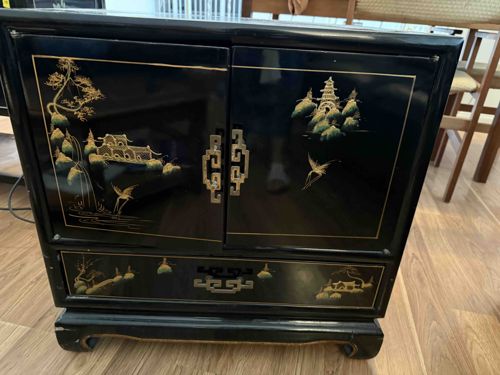
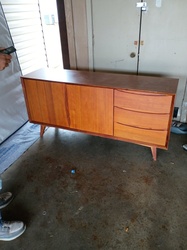
This is a rectangular-shaped, small-scale cabinet, likely constructed from wood and then finished with multiple layers of black lacquer, giving it a high-gloss, reflective surface. The cabinet features two central doors at the top and a single drawer below, all adorned with intricate hand-painted or etched gold and muted green landscape scenes. The artwork depicts traditional Chinese motifs, including pagodas, mountainous terrains with trees, flowing waterfalls, and stylized birds in flight. Each panel (two doors and one drawer front) is framed by a thin gold border, highlighting the detailed illustrations. The hardware consists of two stylized gold-colored pull handles on the doors, designed in an ornamental Chinese longevity or 'shou' character motif, and a single, smaller matching pull on the drawer. The cabinet rests on four short, curved legs, characteristic of many traditional Asian furniture pieces. Visible condition issues include some minor scuffing and loss of finish along the edges and corners, particularly on the legs, consistent with moderate use and age. There are also a few small white marks or specks on the black lacquered surface, which could be cosmetic wear or dust. The craftsmanship appears to be of good quality, with attention paid to the decorative details and the smooth lacquered finish, indicative of a handmade item. The style suggests it is an antique or a vintage reproduction, likely dating from the mid-20th century or later, embodying classic Chinese furniture design.
AI Appraisal Report
I have examined the provided image and description of this Lacquered Chinese Landscape Cabinet. Based on the visual cues, this is a rectangular-shaped cabinet, likely constructed from wood and finished with black lacquer. The intricate gold and muted green landscape scenes, depicting pagodas, mountains, and birds, are a highlight, reflecting traditional Chinese artistry. The hardware, with its longevity motif, further reinforces its cultural origin. The visible condition issues, such as minor scuffing and loss of finish along edges and corners, as well as a few small white marks, are consistent with moderate use and age, as described. These are typical signs of wear for a vintage piece and do not significantly detract from its aesthetic appeal, though they do prevent it from being in pristine condition. The craftsmanship appears to be of good quality, suggesting a handmade item with attention to detail.
Considering market conditions for similar vintage Chinese lacquered furniture, pieces of this scale and decorative quality typically fall within a modest mid-range. While the 'handmade' aspect is positive, without further information, it's difficult to ascertain if this refers to mass-produced handcrafted items or a unique artisan piece. Demand for such items is steady but not exceptionally high, positioning it as a decorative accent piece rather than a major collectible. Rarity is not a significant factor here; while unique in its specific artistry, similar styles were widely produced. Factors impacting value include the artistic quality of the hand-painted scenes, the overall condition of the lacquer, and the integrity of the wooden structure.
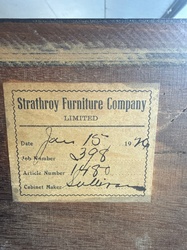
It is important to note the limitations of determining authenticity and exact age from images alone. While the style strongly suggests an antique or vintage reproduction, likely mid-20th century or later, a definitive appraisal would benefit greatly from an in-person examination. Physical inspection would allow me to assess the construction methods, the true nature of the lacquer (e.g., cinnabar vs. paint), and the materials used. Provenance documentation, such as purchase receipts or family history, could further illuminate its origin and potentially increase its value. Scientific testing, like carbon dating, is typically reserved for much older items and is not usually warranted for pieces of this likely vintage. Without physical authentication, my appraisal of $350-750 is based primarily on its decorative merit and condition as a vintage furnishing, assuming it is a good quality vintage reproduction rather than a rare antique.