These notes were written by the person who submitted this item. Appraiser.AI has not verified them, and the AI's identification and estimate may rely on them.
AI Estimated Value
Not an official valuation
$125-200
AI estimate as of August 4, 2025 · verify with a professional before acting
AI-Generated · Verify before acting
Everything on this page is generated by AI for informational purposes only. AI can make mistakes — the AI may misidentify items or misattribute them (artist, maker, brand, designer, origin, era). This is not an official valuation and should not be used for insurance, sale, tax, estate, legal, or lending purposes — or any decision requiring a certified appraisal. It is not an authoritative claim about any person, brand, or rights holder — do not share or rely on it as a factual statement about a third party. Always consult qualified professionals before making financial decisions.
This analysis also relies on unverified notes provided by the user, which may be incomplete or inaccurate and could affect the result.
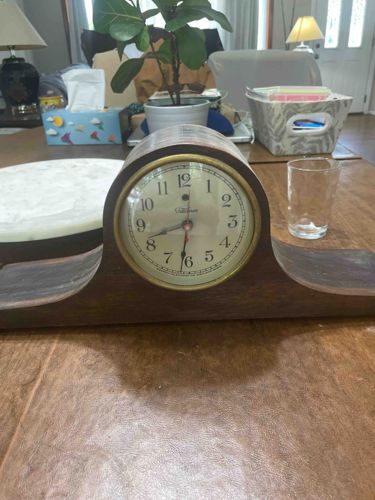
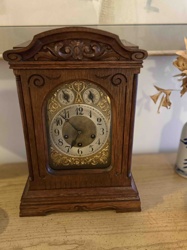
This is a vintage mantle clock, housed in a traditional wooden case with a rounded or arched top and a flat, extended base. The wood appears to be a dark hardwood, possibly walnut or mahogany, exhibiting a rich, warm tone with visible grain patterns. The finish shows some wear and minor scratches consistent with age and use, particularly on the flat top surface of the base, which has lighter areas, possibly from dust or sun exposure, and scuffs. The clock face is round, set within a brass or gold-toned bezel, which has developed a slight patina. The dial is off-white or cream-colored with black Arabic numerals for hours 1 through 12. There are minute markers around the edge. The hands are black, with a classic hour, minute, and a very slender red sweep second hand. The brand name 'Seth Thomas' is visibly printed on the dial below the '12' o'clock position. The glass cover over the dial appears clear and intact. The overall construction suggests a solid, well-made piece, characteristic of early to mid-20th-century American clock manufacturing. The design is somewhat utilitarian, focusing on functionality with a decorative yet understated presence. Given the 'Seth Thomas' branding, it likely dates from the 1900s to mid-1900s. The provided context indicates the movement needs repair, suggesting internal mechanical issues, but externally, the clock maintains a good, albeit used, aesthetic condition.
AI Appraisal Report
Based on my visual examination of the provided image, this Seth Thomas Wooden Mantle Clock appears to be a genuine example of their early to mid-20th-century production. The 'Seth Thomas' branding on the dial, coupled with the characteristic traditional wooden case and design, aligns with known models from the period. The dark hardwood, likely walnut or mahogany, shows an attractive grain. The condition is good for its age; while there are visible signs of wear, minor scratches, and scuffs on the finish, particularly on the base, these are consistent with typical use and do not significantly detract from its aesthetic appeal. The brass bezel has a pleasing patina, and the dial and hands appear original and intact.
My primary limitation in this appraisal is the lack of a physical examination. While the visual cues strongly suggest authenticity, a hands-on inspection would be required to verify the internal components, confirm the originality of the movement, and check for any repairs or replacements not visible externally. Provenance documentation, if available, would further solidify authenticity. Scientific testing, such as wood analysis, would only be pursued if significant doubt arose during physical inspection.
Market conditions for vintage mantle clocks like this are stable. There is a consistent demand from collectors and individuals seeking decorative, functional antique pieces. Seth Thomas clocks are widely recognized and generally well-regarded, making them popular. Though not exceptionally rare, good examples like this, even with mechanical issues, maintain value. The fact that the movement needs repair is the most significant factor impacting value; a fully functional clock would command a higher price. This repair cost must be factored into the overall valuation.
Considering the brand recognition, good external condition, and the acknowledged need for movement repair, this clock represents a desirable item for a collector or enthusiast willing to invest in its restoration.