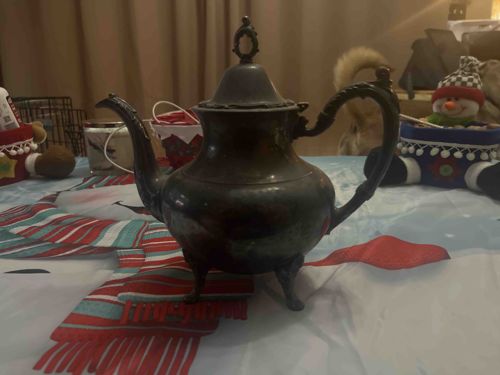
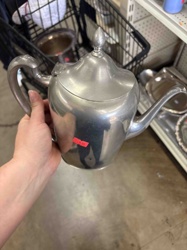
Silver teapot, might be pure silver. At least 60 years old
These notes were written by the person who submitted this item. Appraiser.AI has not verified them, and the AI's identification and estimate may rely on them.
AI Estimated Value
Not an official valuation
$75 - $175
AI estimate as of December 2, 2025 · verify with a professional before acting
AI-Generated · Verify before acting
Everything on this page is generated by AI for informational purposes only. AI can make mistakes — the AI may misidentify items or misattribute them (artist, maker, brand, designer, origin, era). This is not an official valuation and should not be used for insurance, sale, tax, estate, legal, or lending purposes — or any decision requiring a certified appraisal. It is not an authoritative claim about any person, brand, or rights holder — do not share or rely on it as a factual statement about a third party. Always consult qualified professionals before making financial decisions.
This analysis also relies on unverified notes provided by the user, which may be incomplete or inaccurate and could affect the result.
This is an antique or vintage teapot, likely constructed from silver-plated brass or copper, exhibiting a dark, heavily tarnished patina that suggests significant age and exposure. The overall form is a classic elegant silhouette, featuring a bulbous body that tapers towards a narrower neck and a fitted lid. The spout is gracefully curved and extends outward, showing some slight flaring at its tip. A prominent, ornate handle, possibly featuring a C-scroll design with decorative elements, is attached to the body, indicating a traditional aesthetic. The lid is crowned with a finial, which appears to be a smaller, decorative loop or knob, adding to its decorative appeal. The teapot stands on three distinct, claw-foot or similar decorative legs, elevating it from the surface. The surface details are somewhat obscured by the heavy tarnish, but subtle engravings or embossed patterns may be present on the body, handle, and spout, typical of period silver and silver-plated wares. The dark, almost black appearance indicates extensive natural oxidation over time, often a characteristic of older silver-plated items that have not been regularly polished. While the base metal is not precisely discernible from the image, the dark tarnish is consistent with silver plating rather than solid silver unless it is exceptionally old and neglected. The craftsmanship appears to be of a reasonable quality, with attention to decorative elements such as the finial, handle, and feet. Given the provided context that it is at least 60 years old and potentially pure silver, without visible hallmarks, silver plating is a more common material for such heavily ornate pieces from that era.
AI Appraisal Report
Based on my visual examination of the provided image, this antique/vintage teapot presents with a classic elegant silhouette, characterized by a bulbous body, gracefully curved spout, and an ornate C-scroll handle. The presence of a decorative finial and three distinct claw-foot legs further adds to its period appeal. The most striking visual aspect is the heavy, dark tarnish, almost black, covering the entire piece. This extensive natural oxidation is highly consistent with silver-plated items that have aged considerably without regular polishing, as opposed to solid silver which typically tarnishes to a darker grey. While the owner suggested the possibility of pure silver and a minimum age of 60 years, the visual evidence of tarnish strongly points to silver-plated brass or copper as the base metal. Without visible hallmarks, which are crucial for authenticating solid silver, or a lack of wear on high points revealing a base metal, I must assess it as silver-plated at this juncture. The craftsmanship appears reasonable for its type and era.
Market conditions for heavily tarnished, unidentified silver-plated teapots are moderate. While there's a demand for antique decorative items, the lack of clarity on material significantly impacts value. Comparables for tarnished, ornate silverplate typically range from $50 to $200, with items in excellent, polished condition fetching higher prices. Rarity is not exceptionally high for such common forms of silverplate. Factors negatively impacting value include its current tarnished state and the lack of definitive material identification.
For full authentication and a more precise valuation, an in-person examination is essential to: 1) Physically check for hallmarks. 2) Perform a silver test to determine if it is solid silver or plated. 3) Assess the integrity of the plating and any potential base metal exposure. 4) Determine the base metal if plated. Provenance documentation, if available, would also be highly beneficial. Without these steps, the valuation is based on the strong likelihood of it being a silver-plated item in a heavily tarnished condition.