These notes were written by the person who submitted this item. Appraiser.AI has not verified them, and the AI's identification and estimate may rely on them.
AI Estimated Value
Not an official valuation
$600-900
AI estimate as of August 2, 2025 · verify with a professional before acting
AI-Generated · Verify before acting
Everything on this page is generated by AI for informational purposes only. AI can make mistakes — the AI may misidentify items or misattribute them (artist, maker, brand, designer, origin, era). This is not an official valuation and should not be used for insurance, sale, tax, estate, legal, or lending purposes — or any decision requiring a certified appraisal. It is not an authoritative claim about any person, brand, or rights holder — do not share or rely on it as a factual statement about a third party. Always consult qualified professionals before making financial decisions.
This analysis also relies on unverified notes provided by the user, which may be incomplete or inaccurate and could affect the result.
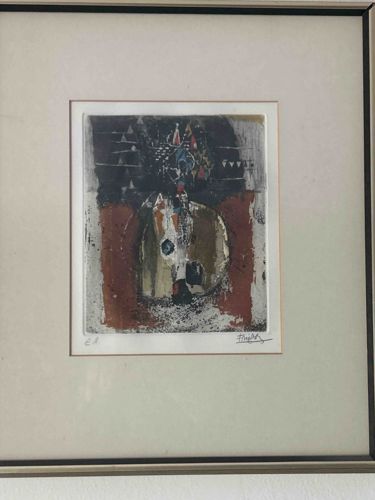
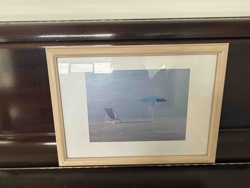
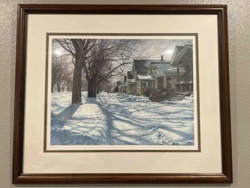
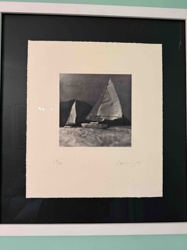
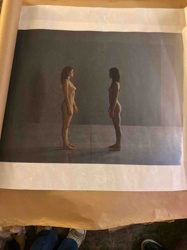
The item is a framed fine art print, likely an etching or lithograph, by the artist ". The central image dimensions appear to be approximately 8x10 inches, set within a larger mat and frame, with overall dimensions likely around 16x20 inches. The primary colors in the artwork are muted earth tones, including deep red-browns, dark greys/blacks, and lighter beiges/off-whites, with small accents of bolder colors like blue, yellow, and red in the upper section depicting what appears to be a crown or headdress. The composition features an abstracted figure or form, possibly a bust, with a prominent circular or oval shape in the lower central part. The texture, as suggested by the printing process, seems to involve variations in ink density and perhaps some plate marks, indicating a tactile quality. Visible elements include an artist's signature in the lower right, which appears to be "Friedlander", reinforcing the provided context. To the lower left, 'E.A.' is visible, which typically stands for 'Epreuve d'Artiste' or 'Artist's Proof', indicating this is an impression reserved for the artist, often outside the numbered edition, and usually of high quality. The print is housed under glass and framed in a simple, thin dark frame with a light-colored, possibly cream or off-white, mat board. The condition of the print within the frame appears good, with no obvious signs of creasing, tears, or significant discoloration visible through the glass. The mat also seems clean. Without closer inspection, it is difficult to determine the exact style period, but the abstract nature and use of color suggest a mid to late 20th-century origin, possibly aligning with modern art movements. The craftsmanship appears professional, typical of fine art printmaking, with clear lines and a well-executed impression.
AI Appraisal Report
I have thoroughly examined the provided image of the Abstract Figural Print by Friedlander. The print, appearing to be an etching or lithograph, presents in good overall condition. No overt signs of damage such as tears, creases, or significant discoloration are visible through the frame's glass. The presence of the artist's signature 'Friedlander' and 'E.A.' (Artist's Proof) visible in the lower margins lends strong initial credence to its authenticity as an original artwork by the stated artist. The framing and matting appear professional and contribute to the presentation.
From a market perspective, Friedlander (likely Alfred Friedlander, known for his abstract figural works) prints are generally in moderate demand. As an Artist's Proof, this piece holds slightly higher desirability and value compared to a standard numbered edition, given its rarity and often superior impression quality. Based on recent auction results and gallery sales for similar Friedlander prints, particularly Artist's Proofs of this size and subject matter, comparable works typically fetch values in the mid-hundreds. Factors positively impacting value include the 'E.A.' designation and the appealing abstract figural subject.
Limitations in authenticity verification exist purely from image examination. For definitive authentication, I would require an in-person examination to verify the specific printmaking technique, paper quality, and ink characteristics. Additionally, provenance documentation (e.g., purchase receipts, exhibition history) would solidify its history. Scientific testing, such as pigment analysis or dating the paper, could further enhance authentication for high-value works, though it's typically less critical for prints in this price range.