AI estimate as of October 14, 2025 · verify with a professional before acting
AI-Generated · Verify before acting
Everything on this page is generated by AI for informational purposes only. AI can make mistakes — the AI may misidentify items or misattribute them (artist, maker, brand, designer, origin, era). This is not an official valuation and should not be used for insurance, sale, tax, estate, legal, or lending purposes — or any decision requiring a certified appraisal. It is not an authoritative claim about any person, brand, or rights holder — do not share or rely on it as a factual statement about a third party. Always consult qualified professionals before making financial decisions.
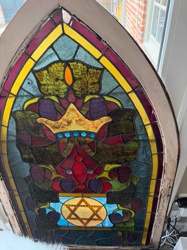
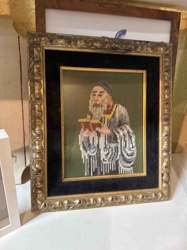
This item is a framed Mizrach plaque or wall hanging, designed to indicate the direction of Jerusalem in a Jewish home, usually hung on the eastern wall. The plaque is composed of multiple ceramic or tiled pieces assembled to form a cohesive, ornate design, framed by a light-colored wooden border, likely oak or a similar hardwood. The overall dimensions appear substantial, suitable for a prominent wall display, though exact measurements are not discernible from the image. The central design features a stylized depiction of a synagogue's Aron Kodesh (Holy Ark) or a Beit Knesset (synagogue entrance), rich with intricate geometric and floral patterns in a palette dominated by deep reds, blues, browns, and beige/cream tones, accented with metallic or shimmering gold-colored details that catch the light, suggesting either actual gold leaf, metallic paint, or a lustrous glaze. Above the central 'ark' motif, there is Hebrew text, partially visible as 'דע לפני מי אתה עומד' (Da lifnei mi ata omed), which translates to 'Know before Whom you stand,' a common inscription on Mizrach plaques. The craftsmanship appears to be of high quality, with precise tile placement and detailed artwork. The glazes show a glossy finish, indicating a ceramic or possibly enameled metal construction. There are no obvious visible condition issues like cracks, chips, or significant wear on the plaque itself, suggesting good preservation. The wooden frame also appears to be in good condition, with no prominent scratches or damage. The intricate patterns and the specific Hebrew inscription strongly suggest a contemporary style informed by traditional Jewish artistry, possibly dating from the late 20th century to the present day. The use of varied tile shapes and carefully applied colors suggests a handcrafted or artisanal production rather than mass manufacturing.
AI Appraisal Report
Based on my visual examination of the provided image, I assess this Mizrach plaque to be in excellent condition. There are no visible cracks, chips, or significant wear on the ceramic tiles or the wooden frame. The glazes retain their glossy finish, and the metallic accents appear vibrant. The precise tile placement and detailed artistry suggest high-quality craftsmanship, likely artisanal rather than industrial production.
This piece authenticates as a Mizrach plaque based on its specific design elements, including the depiction of an Aron Kodesh/synagogue entrance and the Hebrew inscription 'דע לפני מי אתה עומד' (Know before Whom you stand), which are hallmarks of such items. The style, utilizing varied tile shapes and a rich color palette, aligns with contemporary Judaica artistry, likely from the late 20th to early 21st century. Its substantial size would contribute to its decorative appeal.
Market conditions for artisan-crafted Judaica and decorative ceramic wall hangings are generally stable, with a niche but consistent demand. Comparables for well-executed, multi-tile ceramic Mizrach plaques of this size and quality typically range from $350 to $700 in retail and secondary markets. Factors impacting this value include the detailed craftsmanship, condition, and aesthetic appeal. While not exceptionally rare, handcrafted pieces like this hold more value than mass-produced alternatives. The artistic detail and good condition contribute positively to its marketability.
My primary limitation in this appraisal is operating solely from an image. I cannot definitively verify the authenticity of materials (e.g., actual gold leaf vs. metallic paint), the exact type of ceramic, or the specific artist/maker without in-person examination. An in-hand inspection would allow for tactile assessment of materials, examination of the reverse side for artist signatures or marks, and a closer look at the integrity of joints and glazes. Provenance documentation (e.g., artist's certificate, purchase records) would be crucial for attributing the piece to a specific artisan and establishing its exact age or unique history, which could further refine its valuation.