AI estimate as of August 4, 2025 · verify with a professional before acting
AI-Generated · Verify before acting
Everything on this page is generated by AI for informational purposes only. AI can make mistakes — the AI may misidentify items or misattribute them (artist, maker, brand, designer, origin, era). This is not an official valuation and should not be used for insurance, sale, tax, estate, legal, or lending purposes — or any decision requiring a certified appraisal. It is not an authoritative claim about any person, brand, or rights holder — do not share or rely on it as a factual statement about a third party. Always consult qualified professionals before making financial decisions.
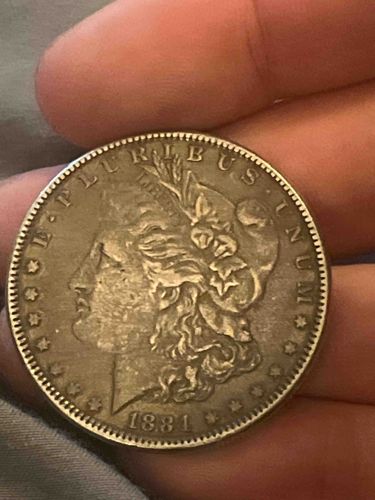
The item is a circular metal coin, appearing to be silver or a silver-colored alloy, with a diameter consistent with historical U.S. dollar coinage. Its primary visible side, the obverse, features a left-facing profile bust of a female figure, widely recognized as Lady Liberty. Her hair is depicted in a detailed, curly fashion, adorned with a cap and what appears to be a sprig of wheat or cotton peeking from behind her head. Above the bust, curved along the rim, are the words "E PLURIBUS UNUM". The date "1881" is prominently displayed below the bust. Surrounding the central image, along the rim, are a series of stars, thirteen in total, representing the original states of the Union. The rim itself features a raised edge, and a reeded or milled pattern is visible on the very outer edge of the coin, a common security feature for historical coinage. The coin exhibits a considerable degree of wear consistent with circulation, particularly on the higher points of Liberty's effigy, such as the cheekbone, ear, and hair details. There is a general toning or patina across the surface, giving it a somewhat darkened, aged appearance rather than a bright, lustrous shine. No specific mint mark is discernible in the provided image, which would typically be located on the reverse. The overall condition suggests a state of fine to very fine (F-VF), with clear details but significant loss of original luster and some flattening of the design elements. This specific design and date identify it as a Morgan Silver Dollar, an American coin minted from 1878 to 1904, and again in 1921. Its craftsmanship is indicative of U.S. Mint production from the late 19th century.
AI Appraisal Report
I have examined the provided image of what appears to be an 1881 Morgan Silver Dollar. Based on the visual evidence, the coin is authentic in design and features consistent with known examples of the Morgan Dollar series. The obverse depicts Lady Liberty, and the date '1881' is clearly visible. The overall condition, as described and depicted, suggests a grade in the Fine to Very Fine (F-VF) range. There is clear evidence of circulation wear, particularly on the high points of Liberty's effigy, such as the cheek and hair, and the original luster is absent, replaced by an aged toning. This wear directly impacts the numismatic value.
Market conditions for common date Morgan Dollars in F-VF condition are stable. The 1881 date is not considered rare, and many millions were minted. Demand remains consistent among collectors, but this particular grade places it outside the premium market for uncirculated or highly graded examples. Comparables in this condition typically trade at a slight premium above their silver melt value. Factors significantly impacting value here are the lack of original luster, the extent of wear, and the absence of a discernible mint mark in the image, which would identify the specific mint and could affect value if it were a scarcer mint.
Limitations in authenticity verification from an image alone are significant. While the design appears correct, I cannot verify the coin's metallic composition, weight, or specific gravity, which are crucial for full authentication and detection of counterfeits. An in-person examination would allow for precise grading using industry standards, weight and diameter checks, edge analysis, and the identification of any potential repairs or alterations. Provenance documentation, though not typically extensive for common circulated coins, could add peace of mind. Scientific testing, such as XRF analysis, would definitively confirm the metal content.