AI estimate as of October 27, 2025 · verify with a professional before acting
AI-Generated · Verify before acting
Everything on this page is generated by AI for informational purposes only. AI can make mistakes — the AI may misidentify items or misattribute them (artist, maker, brand, designer, origin, era). This is not an official valuation and should not be used for insurance, sale, tax, estate, legal, or lending purposes — or any decision requiring a certified appraisal. It is not an authoritative claim about any person, brand, or rights holder — do not share or rely on it as a factual statement about a third party. Always consult qualified professionals before making financial decisions.
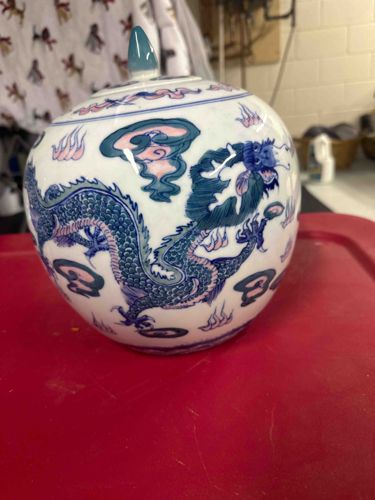
This item is a decorative lidded jar, commonly referred to as a ginger jar, featuring an intricate dragon motif. It is crafted from ceramic, likely porcelain, given its white base and glazed finish. The primary colors used in the decoration are a vibrant cobalt blue for the dragon, accented with softer pink and light teal or turquoise used for cloud-like patterns and some detailing on the dragon itself. The jar has a rounded, squat body, tapering slightly towards the neck where the lid rests, and a base that appears to be flat. The lid is domed with a distinct, tapered finial in a light teal/turquoise color, contrasting with the lid's white body and matching the accent colors on the jar. The dragon depicted is a prominent feature, wrapping around a significant portion of the jar's circumference. It exhibits classic East Asian dragon characteristics, including scales, claws, whiskers, and a fierce expression. Surrounding the dragon are stylized cloud or flame motifs, primarily in pink and teal. Fine details are visible in the dragon's scales and facial features, suggesting a hand-painted application. The overall condition appears good from the visible angle, with no obvious chips, cracks, or significant wear to the glaze. There are no discernible maker's marks or signatures visible in the provided image. The style suggests an East Asian origin, likely Chinese, and due to the traditional nature of the imagery and craftsmanship, it could date from the mid-to-late 20th century, though without hallmarks, a more precise age is difficult to determine. The quality of the painting and the smooth glaze indicate good craftsmanship.
AI Appraisal Report
Upon visual examination of the provided image, I assess this Dragon Motif Ginger Jar to be in good overall condition. The ceramic body appears intact with no visible chips, cracks, or significant glaze loss. The vibrant cobalt blue, pink, and teal decoration is well-preserved. Authenticity, based solely on this image, appears consistent with late 20th-century East Asian decorative ceramics, likely Chinese. The imagery is traditional, but the color palette and execution suggest a more modern production rather than an antique. Without physical inspection, I cannot confirm the exact material (porcelain vs. a different ceramic) or detect hairline fractures, repairs, or subtle manufacturing flaws. Furthermore, the absence of visible maker's marks or signatures limits definitive authentication regarding a specific factory or artist.
Market conditions for decorative ginger jars of this type are moderate. While the dragon motif is popular, this specific style and likely age place it within a broader category of contemporary decorative imports. Comparables would include similar glazed ceramic jars with hand-painted or transfer-printed East Asian motifs, typically found in online marketplaces, antique malls, or estate sales. Demand is steady for attractive decorative pieces, but rarity is low given the probable mass-produced or semi-mass-produced nature. Factors significantly impacting value include the lack of identifiable marks, which prevents attribution to a notable period or maker. The decorative appeal is the primary value driver here.
For full authentication, an in-person examination is crucial to assess clay body, glaze quality under magnification, and any hidden marks. Provenance documentation, though unlikely for such an item, would be beneficial for history, and scientific testing (e.g., thermoluminescence for dating) is not typically warranted for items in this price range.