AI estimate as of July 17, 2025 · verify with a professional before acting
AI-Generated · Verify before acting
Everything on this page is generated by AI for informational purposes only. AI can make mistakes — the AI may misidentify items or misattribute them (artist, maker, brand, designer, origin, era). This is not an official valuation and should not be used for insurance, sale, tax, estate, legal, or lending purposes — or any decision requiring a certified appraisal. It is not an authoritative claim about any person, brand, or rights holder — do not share or rely on it as a factual statement about a third party. Always consult qualified professionals before making financial decisions.
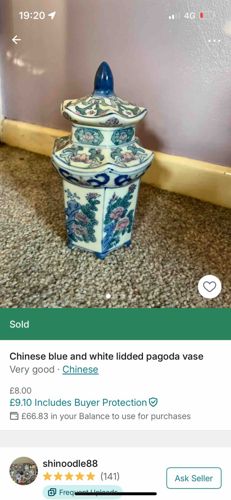
This is a ceramic Chinese blue and white lidded pagoda vase, likely made of porcelain or a fine earthenware, given its delicate appearance and intricate decoration. The vase features a multi-tiered, pagoda-like form. The primary color scheme is off-white or cream for the body, serving as a canvas for hand-painted designs in various shades of blue, pink, green, and possibly other pastels, indicating a 'famille rose' or similar palette integrated with traditional blue and white. The base of the vase appears hexagonal or octagonal in shape, tapering slightly inward before flaring out to form a distinct mid-section, and then narrowing again towards the neck where the lidded top rests. The lid itself mimics the pagoda architecture, topped with a dark blue, possibly cobalt, finial. The surface is adorned with floral motifs, including what appear to be peonies or similar blossoms, intertwined with leafy scrolls and geometric patterns. There are also distinct swirling blue patterns, reminiscent of stylized clouds or waves, on the main body of the vessel. The overall condition appears to be 'very good' as indicated in the provided text, suggesting minimal wear, chips, or cracks. The craftsmanship suggests a decorative piece, possibly from the 20th century, imitating earlier Chinese porcelain styles, though without a visible mark, an exact age or maker is difficult to ascertain. The quality of the painting appears consistent, suggesting a mass-produced decorative item rather than a historically significant antique.
AI Appraisal Report
I have examined the image provided of this Chinese Blue and White Lidded Pagoda Vase. My assessment of its condition, based solely on the visual information, is 'very good', showing no apparent chips, cracks, or significant wear. Authenticity, however, is a complex matter without a direct physical examination. While the piece exhibits characteristics of Chinese decorative arts, its 'famille rose' palette integrated with blue and white, combined with what appears to be consistent, almost mass-produced quality of painting, suggests it is a decorative item likely from the 20th century, imitating earlier styles. It does not appear to be a historically significant antique.
In terms of market conditions, items like this fall into the broad category of decorative Asian ceramics. Demand is moderate for such pieces, particularly those that are attractive and in good condition. However, the market is saturated with similar decorative wares, making it less rare. Comparables would include other 20th-century Chinese-style decorative porcelain vases, often found in estate sales or online marketplaces. Factors impacting value include the lack of a visible artist's mark or reign mark, which prevents precise dating or attribution. The absence of provenance also limits its collectibility among serious antique enthusiasts. Its value is primarily aesthetic.
It is crucial to note the limitations of authenticating from images alone. A full authentication would require in-person examination to assess the porcelain body's quality, weight, glaze nuances, and the true extent of hand-painting versus transferware. Microscopic analysis of the paint pigments and firing techniques could help determine age. Additionally, any hidden marks, wear patterns on the base, or kiln grit could provide critical clues. Provenance documentation, such as collection history or purchase receipts, would also be invaluable for confirming its age and origin. Without these, its classification remains 'decorative' rather than 'antique collectible' for a specialized market.