AI estimate as of August 1, 2025 · verify with a professional before acting
AI-Generated · Verify before acting
Everything on this page is generated by AI for informational purposes only. AI can make mistakes — the AI may misidentify items or misattribute them (artist, maker, brand, designer, origin, era). This is not an official valuation and should not be used for insurance, sale, tax, estate, legal, or lending purposes — or any decision requiring a certified appraisal. It is not an authoritative claim about any person, brand, or rights holder — do not share or rely on it as a factual statement about a third party. Always consult qualified professionals before making financial decisions.
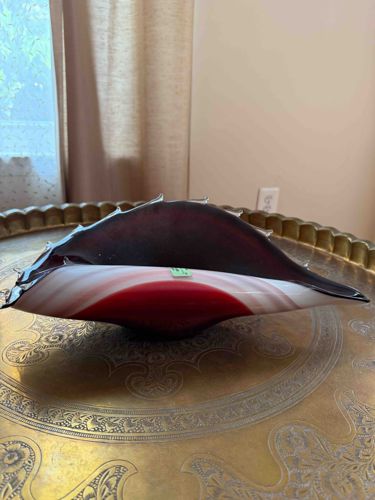
The item is a contemporary art glass bowl or vase, exhibiting a free-form, organic shape that resembles a conch shell or a folded leaf. It is crafted from blown glass, featuring a striking color palette of dark, opaque burgundy or deep plum on the exterior, seamlessly transitioning to a vibrant interior. The interior showcases a broad, horizontal band of vivid red, flanked by swirling patterns of white glass that appear to emanate from the red, suggesting a 'candy cane' or striped effect. Some areas of the white glass exhibit translucent qualities, allowing light to interact with the underlying colors. The dark exterior has a glossy finish, and the edges of the form are uneven and undulating, creating a dynamic silhouette. Along one edge, there are distinct, pointed protrusions or 'spines' that add to its sculptural quality. The base appears to be a flattened, unpolished pontil mark, common in blown glass, providing stability for the piece to rest on a flat surface. There are no visible chips, cracks, or significant abrasions from what can be observed, indicating good general condition. A small, light green rectangular sticker, likely a price or inventory tag, is present on the interior white section. The craftsmanship suggests a studio glass piece, likely from the late 20th or early 21st century, designed as a decorative art object rather than a functional utensil. The quality of the glasswork, particularly the smooth transitions between colors and the intentional shaping, indicates an skilled artisan.
AI Appraisal Report
Upon examining the provided image of this art glass piece, I find it to be in excellent general condition. No chips, cracks, or significant abrasions are visible, which is crucial for art glass. The deliberate free-form, organic shaping, and the smooth transition of colors from the dark exterior to the vibrant red and white interior, strongly suggest a studio glass piece, likely late 20th or early 21st century. The unpolished pontil mark is consistent with hand-blown glass, affirming its artisan nature rather than mass production.
Authenticity verification from images alone has limitations. While the craftsmanship points to a skilled artisan, definitive attribution to a specific artist or studio is impossible without provenance documentation, such as artist signatures, purchase receipts, or exhibition history. An in-person examination would allow for tactile inspection of the glass quality, precise measurement, and a closer look at the pontil and any subtle maker's marks. Scientific testing, like spectroscopic analysis, is generally not required for contemporary decorative glass unless there are questions of material composition.
Regarding market conditions, contemporary studio art glass, particularly sculptural pieces of this quality, experiences consistent demand. Collectors often seek unique, visually striking items. Comparables would include works by unlisted or lesser-known studio artists producing similar scale and complexity. The vibrant color combination and dynamic form enhance its aesthetic appeal and thus its marketability. Rarirty in this context pertains more to the unique nature of individual free-form pieces rather than the artist's overall output. The absence of an artist's signature or established provenance significantly impacts the top end of its potential value. Without the ability to attribute it to a known glass artist, it is valued primarily as a decorative art object.