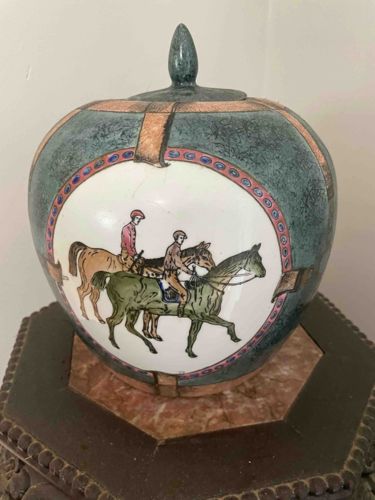
Unknown age made in Chinese bell jar. Jockeys on green background
These notes were written by the person who submitted this item. Appraiser.AI has not verified them, and the AI's identification and estimate may rely on them.
AI Estimated Value
Not an official valuation
$100-200
AI estimate as of July 20, 2025 · verify with a professional before acting
AI-Generated · Verify before acting
Everything on this page is generated by AI for informational purposes only. AI can make mistakes — the AI may misidentify items or misattribute them (artist, maker, brand, designer, origin, era). This is not an official valuation and should not be used for insurance, sale, tax, estate, legal, or lending purposes — or any decision requiring a certified appraisal. It is not an authoritative claim about any person, brand, or rights holder — do not share or rely on it as a factual statement about a third party. Always consult qualified professionals before making financial decisions.
This analysis also relies on unverified notes provided by the user, which may be incomplete or inaccurate and could affect the result.
This item is a decorative covered jar, likely a 'ginger jar' or 'bell jar' as per the context, crafted from ceramic or porcelain. Its form is bulbous with a flattened top and a fitted lid crowned with a finial. The dominant color on the body of the jar is a muted, textured teal or blue-green, possibly a mottled glaze or a patinated finish, giving it an aged appearance. This teal background is segmented by vertical and horizontal decorative bands, appearing to be in a terracotta or reddish-brown hue outlined in black, mimicking a strapped or paneled construction. The jar features a prominent, circular cartouche on its front, rendered in a clean white porcelain base, within which a detailed equestrian scene is depicted. This scene includes at least two jockeys on horseback, rendered with visible brushstrokes, indicating hand-painted decoration. One jockey in a pink or red top rides a light brown horse, while another in a lighter, possibly tan or grey top, rides a more greenish-toned horse. The horses are depicted in various gaits, suggesting movement and activity. Surrounding this central equestrian scene, the white cartouche is bordered by a continuous decorative band of small, dark blue circular motifs against a pink or fuchsia background, further enhancing the visual appeal. The lid of the jar is similarly teal-colored with a matching finial, suggesting continuity in design. The base of the jar rests on an octagonal wooden stand with a visible mottled brown or reddish-brown top surface, possibly marble or a marbleized finish, which is not part of the jar itself but is shown in the image. Although specific maker's marks are not visible, the hand-painted details and the overall design suggest a possible vintage or antique origin, likely from the early to mid-20th century, or a more contemporary piece replicating traditional styles. The term 'Chinese bell jar' from the context suggests it might be an East Asian-influenced or manufactured piece, though the equestrian theme is more commonly associated with Western decorative arts. The condition shows some minor surface wear consistent with age and handling, but no major cracks or chips are immediately apparent. The craftsmanship appears to be of good quality, with clear delineation in the painted decor.
AI Appraisal Report
Based on my visual examination of the provided image and the owner's description, this Equestrian Themed Covered Jar, described as a 'Chinese bell jar,' presents as a decorative ceramic or porcelain piece. The teal body with terracotta-like banding and the finely detailed, hand-painted equestrian cartouche suggest a piece crafted with attention to detail. The visible brushstrokes in the jockey figures enhance its artisanal appeal.
From the image, the condition appears good, with only minor surface wear consistent with age and handling, and no immediately apparent chips or cracks. However, a full assessment of its condition, including hairline cracks, restorations, or crazing, would require an in-person physical inspection.
Authenticity is difficult to ascertain solely from images. While described as a 'Chinese bell jar,' the equestrian theme is more commonly associated with Western decorative arts, which could suggest an export piece, an homage, or simply a misnomer by the owner. Without visible maker's marks or provenance, determining its exact origin (e.g., specific Chinese kiln, European manufacturer) and date is speculative. The design aesthetic suggests a mid-20th-century decorative item, though it could be a more recent reproduction.
In terms of market conditions, decorative covered jars, particularly those with unique hand-painted scenes, maintain a steady but not exceptionally high demand. The equestrian theme appeals to a niche market of horse enthusiasts and collectors of sporting art. Comparables would include other hand-painted decorative ceramics of similar size and artistic quality, often found in estate sales or online marketplaces. Rarity is moderate; while not unique, similarly detailed pieces aren't mass-produced.
The primary factors impacting value are the hand-painted decor, the overall aesthetic appeal, and its condition. Limitations in my remote appraisal include the inability to: inspect the ceramic body for subtle flaws (e.g., repairs, extensive crazing), confirm the material (e.g., porcelain vs. earthenware), examine the base for maker's marks, or assess its weight and feel. Scientific testing of glazes or materials would be necessary for definitive age verification. Provenance documentation (e.g., original purchase receipts, prior ownership history) would significantly aid in authenticating its origin and age, thereby strengthening its market value.