AI estimate as of August 17, 2025 · verify with a professional before acting
AI-Generated · Verify before acting
Everything on this page is generated by AI for informational purposes only. AI can make mistakes — the AI may misidentify items or misattribute them (artist, maker, brand, designer, origin, era). This is not an official valuation and should not be used for insurance, sale, tax, estate, legal, or lending purposes — or any decision requiring a certified appraisal. It is not an authoritative claim about any person, brand, or rights holder — do not share or rely on it as a factual statement about a third party. Always consult qualified professionals before making financial decisions.
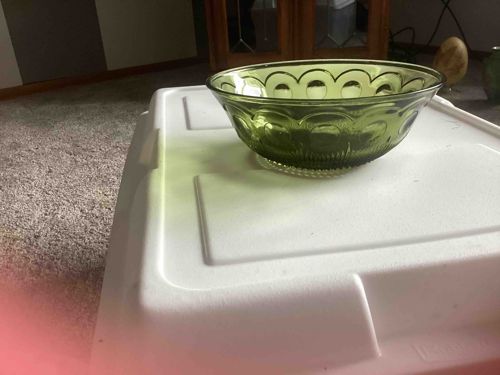
The item is a circular glass bowl, exhibiting a distinct olive green or forest green hue. Its material appears to be pressed glass, characteristic of manufacturing techniques often employed during the mid-20th century. The bowl features a decorative band around its rim, consisting of a series of large, arched or scalloped impressions, creating a repeating pattern. Below this, the main body of the bowl is smooth until it reaches the lower portion, which is adorned with vertical ribbed or fluted detailing, adding texture and visual interest. The base of the bowl is flat and appears to have a slightly raised rim or a subtle hobnail-like texture on its underside, designed to provide stability. From the image, the bowl appears to be in good overall condition, with no immediate visible chips, cracks, or significant wear. There might be some minor surface dust or reflections, but no major condition issues are apparent. The craftsmanship indicates a mass-produced item, yet with attention to decorative detail, consistent with common household glassware from earlier decades, possibly from the mid-century modern era (1940s-1960s). Its size cannot be precisely determined without comparative objects, but it seems to be a medium-sized serving or fruit bowl, suitable for a table centerpiece.
AI Appraisal Report
Upon visual examination of the provided image, this green pressed glass decorative bowl presents as a well-preserved example of mid-20th-century mass-produced glassware. The rich olive/forest green hue is appealing, and the distinct decorative band with scalloped impressions, along with the vertical ribbed detailing, adds significant aesthetic value. The bowl appears to be in very good overall condition, showing no immediate signs of chips, cracks, or significant abrasions. This excellent condition is a primary factor in its valuation, as condition is paramount for glassware collectors.
Authenticity, based on design and typical manufacturing attributes, appears consistent with pressed glass from the 1940s-1960s. However, it's crucial to note that full authenticity verification would ideally require in-person examination to assess glass quality, mold lines, and potential maker's marks which are not discernible from the image. Provenance documentation, though rare for such common items, would also be beneficial.
While not exceedingly rare, decorative pressed glass like this finds a steady market among collectors of vintage home decor and mid-century modern enthusiasts. Demand is moderate, driven by its decorative appeal and utility. Comparable items, typically unbranded and mass-produced, sell in a relatively accessible range. Factors impacting value positively include its appealing color and good condition; conversely, its commonality as a mass-produced item limits significant appreciation. Without physical inspection, precise identification of the manufacturer or specific pattern is impossible, which could otherwise influence value.
To conduct a complete appraisal, I would require a physical inspection to check for subtle imperfections, assess the exact weight and thickness of the glass, and search for mold numbers or maker's marks, which are vital for definitive identification and authenticity. Spectral analysis or similar scientific testing is not typically applied to items of this type and value.