These notes were written by the person who submitted this item. Appraiser.AI has not verified them, and the AI's identification and estimate may rely on them.
AI Estimated Value
Not an official valuation
$100-200
AI estimate as of September 5, 2025 · verify with a professional before acting
AI-Generated · Verify before acting
Everything on this page is generated by AI for informational purposes only. AI can make mistakes — the AI may misidentify items or misattribute them (artist, maker, brand, designer, origin, era). This is not an official valuation and should not be used for insurance, sale, tax, estate, legal, or lending purposes — or any decision requiring a certified appraisal. It is not an authoritative claim about any person, brand, or rights holder — do not share or rely on it as a factual statement about a third party. Always consult qualified professionals before making financial decisions.
This analysis also relies on unverified notes provided by the user, which may be incomplete or inaccurate and could affect the result.
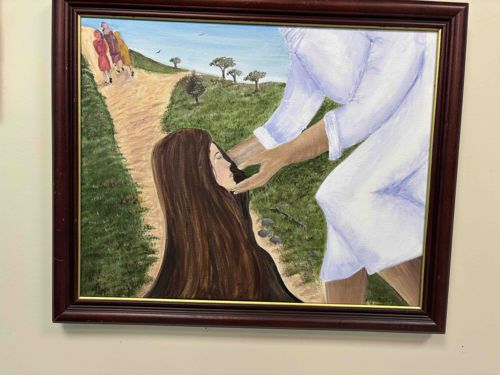
This is an acrylic on canvas painting, measuring 16 inches by 20 inches, created by artist Mary Chesney. The artwork depicts a spiritual or biblical scene, likely related to the parable of the lost sheep, given the context of a shepherd figure and a person in distress. The foreground prominently features a person, presumably female, with long, flowing brown hair, depicted in a submissive or comforted posture, with their eyes closed and face turned towards a larger figure. This larger figure, dressed in flowing white robes, has hands gently cradling the face of the smaller figure, suggesting compassion and care. The background shows a winding, unpaved path on a grassy hillside, with several stylized trees dotting the landscape. In the upper left background, three smaller figures are walking down the path, perhaps symbolizing the flock or other individuals in a journey. The painting uses a palette dominated by earthy greens and browns for the landscape, contrasting with the vibrant white of the main figure's robes and the rich brown of the other figure's hair. The style appears to be representational with a somewhat simplified and illustrative quality, focusing on emotional connection rather than hyper-realism. There are no visible condition issues such as wear, damage, or repairs in the provided image. The painting is framed in a dark reddish-brown wooden frame with a subtle gold inner border, which enhances the artwork without overpowering it. The frame shows minor signs of wear consistent with handling, specifically a small scuff mark on the top left corner. The craftsmanship of the painting appears amateur to mid-level, with clear brushstrokes and a direct application of paint. The overall impression is one of heartfelt expression and spiritual theme.
AI Appraisal Report
Based on my visual examination of the provided image, this 16”x20” acrylic on canvas by Mary Chesney, titled 'The Lord and the Lost Sheep,' appears to be in excellent condition. There are no visible condition issues with the painting itself, such as tears, paint loss, or significant wear. The frame exhibits minor wear consistent with handling, specifically a small scuff on the top left. The authenticity is presumed based on the owner's statement; however, without a physical examination of the artist's signature, if present, or historical provenance documentation, I cannot definitively authenticate authorship from an image alone. An in-person inspection would allow for examination of brushwork nuances, canvas type, and signature details, while provenance documents (e.g., gallery receipts, artist records) would solidify authenticity.
From a market perspective, works by artists like Mary Chesney, who appear to be amateur to mid-level with a representational yet illustrative style, typically fall into the decorative art category. Demand for such pieces is generally localized and driven by aesthetic appeal rather than significant artistic renown or investment potential. Comparable sales data for similar-sized acrylic paintings by artists without established auction records or gallery representation suggest a value range. While the spiritual theme might appeal to a specific niche market, there's no inherent rarity that would significantly inflate its value. The craftsmanship, though heartfelt, displays clear brushstrokes and direct application, indicating a level of skill suitable for emerging artists or hobbyists rather than professional gallery artists. Factors impacting value here are primarily the painting's good condition and its pleasant, thematic subject matter. The value is largely decorative due to the lack of an established market for the artist. Scientific testing, such as pigment analysis, would not be necessary or beneficial for this type of artwork in verifying authenticity or value.