AI estimate as of September 25, 2025 · verify with a professional before acting
AI-Generated · Verify before acting
Everything on this page is generated by AI for informational purposes only. AI can make mistakes — the AI may misidentify items or misattribute them (artist, maker, brand, designer, origin, era). This is not an official valuation and should not be used for insurance, sale, tax, estate, legal, or lending purposes — or any decision requiring a certified appraisal. It is not an authoritative claim about any person, brand, or rights holder — do not share or rely on it as a factual statement about a third party. Always consult qualified professionals before making financial decisions.
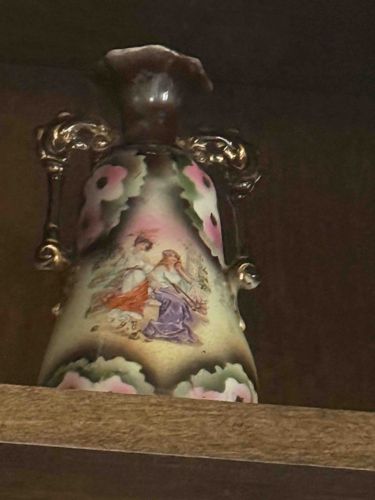
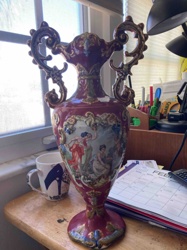
This item is an ornate porcelain urn, characterized by its bulbous body that tapers towards a narrow neck and a distinctive, flaring rim. The primary material appears to be glazed porcelain, exhibiting a lustrous finish. The color palette is rich and varied, with the main body featuring a light, possibly ivory or cream base color, accented by broad, hand-painted floral motifs in shades of pink, green, and dark brown that undulate across the surface, framing the central pictorial scene. The most prominent feature is a hand-painted depiction of two classical female figures, possibly muses or mythological goddesses, rendered in soft, flowing drapery of purple, orange, and white, set against a pastoral landscape with trees and clouds. This central cartouche is encircled by the aforementioned floral outlines. The urn is embellished with two elaborate, scrolled handles, appearing to be gilded in a bright gold, adding a touch of opulence. These handles are attached near the top of the body, just below the neck. The rim also shows traces of gilding, though it appears somewhat worn or discolored in areas, suggesting age. The overall condition, based on the image, shows minor wear consistent with its age, possibly some loss of gilding on the handles and rim, and potentially some surface dirt. The craftsmanship suggests a decorative piece from the late 19th or early 20th century, likely in a Neo-classical or Rococo revival style, aimed at aesthetic appeal rather than utilitarian function. The details of the painting and the intricate handle design point to a piece of moderate to high quality.
AI Appraisal Report
Upon visual examination of the provided image of this porcelain urn, I observe a charming and decorative piece. The bulbous form, tapering neck, and flaring rim are characteristic of decorative urns from the late 19th to early 20th century. The hand-painted classical figures, likely muses or goddesses, set within a pastoral scene, along with the extensive floral motifs in pink, green, and dark brown, suggest a Neo-classical or Rococo Revival influence. The glazed porcelain has a lustrous finish, and the elaborate scrolled handles, appearing gilded, add to its ornate appeal.
In terms of condition, I note minor wear consistent with its age, specifically some apparent loss or discoloration of the gilding on the handles and rim. There may also be some surface dirt, which could be addressed with careful cleaning. The overall integrity of the piece appears sound, with no visible major cracks or chips, though these are difficult to ascertain definitively from an image.
Market conditions for decorative porcelain urns of this period are moderate. While there is a consistent demand for well-executed pieces, the market is not experiencing a sudden surge. Comparables in this quality range, featuring hand-painted scenes and gilded accents, typically fetch in the mid to high hundreds. The perceived quality of the hand-painting and the intricacy of the handle design are positive value factors. However, without a maker's mark, attribution remains elusive, which slightly limits its upper market potential.
For a full authentication and more precise valuation, an in-person examination is crucial. This would allow me to inspect for any subtle repairs, assess the exact condition of the gilding and porcelain surface, and search for any maker's marks or signatures that may be hidden or difficult to discern in the image. Scientific testing of the porcelain or pigments could confirm age, and provenance documentation, if available, would significantly enhance its verifiable authenticity and value.