AI estimate as of July 19, 2025 · verify with a professional before acting
AI-Generated · Verify before acting
Everything on this page is generated by AI for informational purposes only. AI can make mistakes — the AI may misidentify items or misattribute them (artist, maker, brand, designer, origin, era). This is not an official valuation and should not be used for insurance, sale, tax, estate, legal, or lending purposes — or any decision requiring a certified appraisal. It is not an authoritative claim about any person, brand, or rights holder — do not share or rely on it as a factual statement about a third party. Always consult qualified professionals before making financial decisions.
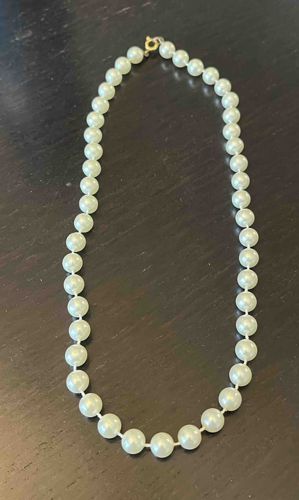
This is a single strand pearl necklace, approximately 18-20 inches in length, featuring uniform, round, off-white or cream-colored beads. Each bead appears to be individually knotted on a visible white thread, which is a sign of quality craftsmanship typically used to prevent all pearls from scattering if the string breaks and also to minimize friction between pearls. The pearls themselves exhibit a moderate luster with some subtle green undertones, which might suggest either a specific type of artificial pearl or a coating that has slightly discolored over time. There are no obvious surface blemishes or chips visible on the individual pearls. The clasp is a small, brass-toned or gold-plated spring ring clasp, which is commonly found on vintage costume jewelry. The metal of the clasp shows no significant tarnishing or wear, indicating it is either well-maintained or not extensively used. There are no discernible maker's marks, signatures, or stamps visible on the clasp or any part of the necklace from the provided images. Given the style of the uniformly sized beads and the spring ring clasp, the necklace likely dates from the mid-20th century, possibly the 1950s to 1970s. Its overall condition appears to be good with minimal signs of wear. The visible stringing method enhances its perceived quality.
AI Appraisal Report
Upon examining the provided image of this single strand faux pearl necklace, I assess its condition as good, showing minimal signs of wear. The uniform, round, off-white/cream-colored beads exhibit a moderate luster with subtle green undertones. The individual knotting on a visible white thread is a significant indicator of quality craftsmanship, enhancing its perceived value and durability. The small, brass-toned or gold-plated spring ring clasp appears well-maintained with no significant tarnishing. Based on the style and clasp, I concur with the likely dating of mid-20th century, possibly 1950s-1970s.
From a market perspective, comparable vintage faux pearl necklaces of similar quality and condition typically fetch modest prices. While individually knotted strands are a desirable feature, the 'faux' nature of the pearls inherently limits their upper value. Demand for such pieces is generally stable among collectors of vintage costume jewelry, but not exceptionally high. Rarity is not a significant factor here; similar styles were mass-produced. The lack of maker's marks, while common for costume jewelry of this era, prevents attribution to a specific, potentially more valuable designer.
The most significant factor impacting value is the material: these are faux pearls. Had they been genuine pearls, even freshwater, the value would be substantially higher. Their vintage appeal and good condition are positive influences.
It is crucial to note the limitations of authenticity verification from images alone. Without physical inspection, I cannot definitively confirm the exact material composition of the 'pearls' (e.g., glass, plastic, shell-based), the true metal content of the clasp, or thoroughly assess the integrity of the stringing. In-person examination would allow for tactile assessment, precise measurement, and under-magnification inspection to confirm material authenticity and thoroughly evaluate manufacturing quality. Scientific testing, such as specific gravity tests or X-ray fluorescence (XRF) for the clasp, would be necessary for full material authentication, if true pearl identity was suspected.