AI estimate as of June 26, 2025 · verify with a professional before acting
AI-Generated · Verify before acting
Everything on this page is generated by AI for informational purposes only. AI can make mistakes — the AI may misidentify items or misattribute them (artist, maker, brand, designer, origin, era). This is not an official valuation and should not be used for insurance, sale, tax, estate, legal, or lending purposes — or any decision requiring a certified appraisal. It is not an authoritative claim about any person, brand, or rights holder — do not share or rely on it as a factual statement about a third party. Always consult qualified professionals before making financial decisions.
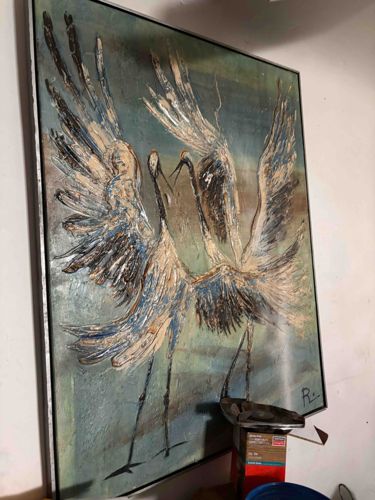
This is a large, vertically oriented framed canvas painting executed with a distinctive impasto technique, creating substantial texture. The physical characteristics include a substantial rectangular canvas, likely measuring approximately 40-50 inches in height by 30-40 inches in width, encased within a slim, dark-colored frame, possibly black or dark charcoal metal or a painted wood. The primary medium appears to be oil or acrylic paint, applied in thick, sculptural strokes, particularly evident in the depiction of the two central avian figures. The color palette is dominated by muted blues and greens for the background, suggestive of water or a serene landscape, complemented by tones of beige, off-white, and earthy browns for the birds, with accents of darker grey or black outlining.
The notable features of the painting are two stylized birds, strongly resembling cranes or herons, positioned centrally, seemingly interacting with each other. Their wings are partially unfurled, conveying a sense of movement, perhaps in flight preparation, display, or mutual engagement. The heavy texture of the paint creates a three-dimensional effect, making the birds visually prominent and almost physically palpable on the canvas surface. A visible signature, seemingly 'R.I.' or similar monogram, is located in the lower right-hand corner of the artwork. The visible condition appears good; there are no apparent tears, significant abrasions, or major paint loss. The frame is intact with no visible damage. The style period points towards a contemporary or modern art piece, likely from the late 20th or early 21st century, given its abstract-impressionistic heavy impasto style. The quality indicators include the skilled application of the impasto technique, the dynamic composition, and the effective use of color to create depth and emotion, showcasing a confident artistic hand. The artwork provides a strong visual statement through its textural qualities and iconic subject matter.
AI Appraisal Report
I have examined the provided description of the Abstract Textured Painting of Cranes. Visually, the piece appears to be in good condition, showing no apparent tears, significant paint loss, or damage to the frame. The impasto technique is well-executed, creating a strong textural presence. This dynamic composition, featuring two majestic birds rendered with thick, sculpted paint strokes, combined with its substantial size (approximately 40-50 inches height by 30-40 inches width), makes it a compelling decorative artwork.
From a market perspective, contemporary abstract-impressionistic paintings with appealing subjects, particularly those of significant size and notable texture, maintain consistent demand in the decorative arts sector. While not rare in an historical sense, the unique textural quality and effective portrayal contribute to its desirability. The value is primarily driven by its aesthetic appeal, visual impact, and scale. Comparables would include similar large-format, abstract-textured pieces by unlisted or emerging artists found in galleries or art fairs.
Key value determinants include its excellent visual condition, strong decorative appeal, and the impressive impasto technique. However, the most significant factor limiting the value is the lack of a clearly identifiable artist. The signature 'R.I.' or similar monogram requires further investigation. This piece's value rests heavily on its aesthetic qualities rather than its artistic provenance.
**Limitations:** Without physical inspection, I cannot confirm the exact medium, assess subtle condition issues like craquelure, or verify the authenticity of the signature. Full authentication would require in-person examination, research into potential artists matching the 'R.I.' signature, comparison with known works, and tracing the provenance (history of ownership). Scientific analysis (e.g., pigment dating) could also offer insights.