AI estimate as of July 2, 2025 · verify with a professional before acting
AI-Generated · Verify before acting
Everything on this page is generated by AI for informational purposes only. AI can make mistakes — the AI may misidentify items or misattribute them (artist, maker, brand, designer, origin, era). This is not an official valuation and should not be used for insurance, sale, tax, estate, legal, or lending purposes — or any decision requiring a certified appraisal. It is not an authoritative claim about any person, brand, or rights holder — do not share or rely on it as a factual statement about a third party. Always consult qualified professionals before making financial decisions.
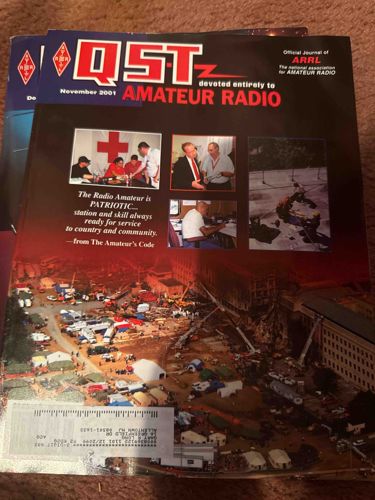
This item is identified as the November 2001 issue of QST, the official journal of ARRL (the national association for Amateur Radio). The magazine features a dark background, likely a deep reddish-brown or burgundy, with the title 'QST' prominently displayed in large red capital letters, with a 'Z' design integrated into the 'T'. Below the QST title, it states 'devoted entirely to AMATEUR RADIO' in white and red text. The cover's central theme appears to be the role of amateur radio operators in emergency situations, particularly in the aftermath of a significant event (strongly suggesting 9/11 given the November 2001 date and imagery). The lower two-thirds of the cover display a detailed aerial photograph of a disaster zone, showing debris, emergency vehicles, and multiple tents, reminiscent of a large-scale recovery effort at the Pentagon. Several inset pictures are featured: one shows individuals, possibly amateur radio operators, working around a table with a red cross symbol in the background; another shows two men in suits, one holding a document; and a third shows a man seated at a desk with radio equipment. Text on the cover reads, 'The Radio Amateur is PATRIOTIC... station and skill always ready for service to country and community. – from The Amateur's Code.' The visible condition of the magazine appears generally good, with some slight curling or wear along the edges, consistent with a paper periodical of its age. A mailing label with a barcode and address information (partially obscured) is present at the bottom left of the cover. The publication date of November 2001 places it firmly in the early 21st century, a significant period for emergency preparedness and response.
AI Appraisal Report
I have carefully examined the provided image of the QST Magazine, November 2001 Issue. Visually, the magazine appears to be in good, used condition, commensurate with its age as a paper periodical from 2001. There is noticeable slight curling or wear along the edges, and the presence of a mailing label with address information is typical for subscriber copies. These minor imperfections do not significantly detract from its overall appeal for a collector of periodicals, but do prevent it from being graded as 'mint' or 'near mint'.
Authenticity: Based solely on the visual cues in the image, the magazine appears authentic. The distinctive 'QST' masthead, the 'devoted entirely to AMATEUR RADIO' tagline, and the ARRL affiliation are all consistent with genuine issues of QST. The cover content, particularly the aerial photograph of a disaster zone and the emergency response theme, strongly aligns with the November 2001 publication date, placing it in the context of the 9/11 aftermath and the role of amateur radio in emergency communications. However, without physical inspection, I cannot verify paper quality, binding integrity, or the absence of internal damage, missing pages, or non-period correct alterations. Full authentication would require in-person examination to check paper stock, printing methods, and full content verification against known authentic copies. Provenance documentation, such as original subscriber records, would also add to authentication but is unlikely for a mass-produced magazine.
Market Conditions and Comparables: QST magazines are generally not considered rare due to their large circulation among amateur radio enthusiasts. Most back issues, even older ones, can be found relatively easily. However, issues tied to significant historical events can sometimes command a slight premium, particularly if the cover and content directly address the event. The November 2001 issue falls into this category, as it specifically highlights amateur radio's role in the 9/11 response. Comparable sales for general QST back issues typically range from $5 to $15. Issues with direct historical relevance might reach $20-$30, especially if in excellent condition.
Demand and Rarity: While not rare, there is a consistent demand among amateur radio operators for historical issues of QST, particularly those documenting important events or technical advancements. The historical significance of this specific issue, chronicling amateur radio's response to 9/11, makes it more desirable than a typical back issue. However, given the millions of copies likely printed, it is not a 'rare' item in the traditional sense. Its value is primarily driven by its historical content rather than scarcity.
Factors Impacting Value: The primary value driver here is the historical context of the 9/11 emergency response. The visibility of the original mailing label, while common, slightly diminishes aesthetic appeal for some collectors but confirms it as a distributed subscriber copy. Its overall good, but not perfect, condition means it will not achieve the highest possible price for this specific issue. Physical inspection would allow for a more precise condition assessment (e.g., presence of creases, tears, spine integrity, water damage, or mold) which could significantly adjust this appraisal.
Overall, while historically significant, this remains a mass-produced magazine, limiting its top-end value. The discernible wear and the presence of a mailing label are minor detractions from what might otherwise be a slightly higher appraisal for a truly pristine copy of this historically relevant issue.