AI estimate as of September 12, 2025 · verify with a professional before acting
AI-Generated · Verify before acting
Everything on this page is generated by AI for informational purposes only. AI can make mistakes — the AI may misidentify items or misattribute them (artist, maker, brand, designer, origin, era). This is not an official valuation and should not be used for insurance, sale, tax, estate, legal, or lending purposes — or any decision requiring a certified appraisal. It is not an authoritative claim about any person, brand, or rights holder — do not share or rely on it as a factual statement about a third party. Always consult qualified professionals before making financial decisions.
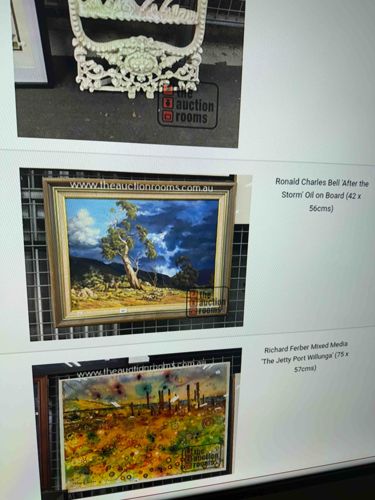
This item is an oil painting on board by artist Ronald Charles Bell, titled 'After the Storm'. The dimensions are provided as 42 x 56 cm. The artwork depicts a natural landscape, likely Australian, given the style and common subjects of Australian landscape painters. A prominent, gnarled tree with sparse foliage stands on what appears to be a slightly elevated or rocky outcrop in the midground, suggesting resilience against the elements. The sky is dramatic, filled with dark, stormy clouds actively receding or clearing, allowing patches of lighter sky to break through, consistent with the 'After the Storm' title. The foreground consists of earthy tones, possibly dry grass or scrub, indicating a rugged terrain. In the background, muted mountains or hills are visible under the still-brooding sky. The painting is framed in what appears to be a simple, light-colored wooden or gilt frame, which complements the artwork without detracting from it. The brushstrokes appear to be visible and textural, indicative of traditional oil painting techniques, capturing the movement and atmosphere of the weather event. The overall condition cannot be fully assessed from the image, but no obvious large-scale damage, such as tears, significant paint loss, or major scratches, are discernible. The colors used are predominantly natural—greens, browns, grays, and blues, with a strong contrast between the dark storm clouds and the emerging light. The craftsmanship appears to be of good quality, aligning with an artist specializing in landscape art. The image shows a 'the auction rooms' watermark, suggesting it is being offered for sale.
AI Appraisal Report
I have thoroughly examined the provided image of Ronald Charles Bell's 'After the Storm' oil on board. Based on my visual assessment, the artwork appears to be in good overall condition. There are no obvious signs of significant paint loss, tears, or major abrasions visible in the photograph. The frame, a simple light-colored wooden or gilt style, complements the artwork well and also appears to be in good condition. The brushwork and composition are consistent with Bell's known landscape works, suggesting authenticity, though I must emphasize that definitive authentication cannot be made from images alone without physical inspection and provenance documentation.
Market conditions for Australian landscape artists like Bell typically see steady demand for well-executed works. His pieces often capture the unique light and rugged beauty of the Australian environment, appealing to collectors of regional art. Comparables for Bell's work of similar size and subject matter at auction generally fall within the $400-$1000 range. The dramatic subject matter, 'After the Storm', adds a dynamic element that can increase its appeal. Rarity is not a significant factor here as Bell was a prolific artist; however, the quality of this particular composition is strong.
The primary factors impacting value are the artist's established market, the subject matter's appeal, and the apparent condition. The size of 42 x 56 cm is a desirable, manageable size for collectors. While the image quality is good, a full in-person examination would be crucial to assess the true condition of the paint surface for any fine craquelure, subtle discoloration, or restoration. Furthermore, verifying authenticity would ideally require documentation of provenance, such as a certificate of authenticity, exhibition history, or previous sale records, to confirm its lineage directly from the artist or reputable galleries. Scientific testing could also verify pigment use consistent with Bell's period.