These notes were written by the person who submitted this item. Appraiser.AI has not verified them, and the AI's identification and estimate may rely on them.
AI Estimated Value
Not an official valuation
$75 - $125
AI estimate as of August 3, 2025 · verify with a professional before acting
AI-Generated · Verify before acting
Everything on this page is generated by AI for informational purposes only. AI can make mistakes — the AI may misidentify items or misattribute them (artist, maker, brand, designer, origin, era). This is not an official valuation and should not be used for insurance, sale, tax, estate, legal, or lending purposes — or any decision requiring a certified appraisal. It is not an authoritative claim about any person, brand, or rights holder — do not share or rely on it as a factual statement about a third party. Always consult qualified professionals before making financial decisions.
This analysis also relies on unverified notes provided by the user, which may be incomplete or inaccurate and could affect the result.
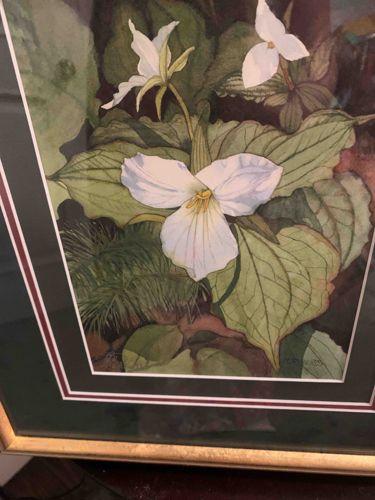
This item is a framed botanical art print, specifically a watercolor reproduction depicting Trillium flowers. The primary subject is a large, central white trillium in full bloom, with its characteristic three petals and a yellow stamen cluster at its center. Two smaller trillium blooms are visible in the background, one to the upper left and another partially obscured to the upper right. The flowers are surrounded by lush green foliage, including broad, veined leaves typical of the Trillium plant and some darker, more indistinct green elements that suggest a natural, wooded undergrowth. The color palette is naturalistic, featuring various shades of green for the leaves and stems, pure white with subtle grey shading for the petals, and hints of brown in the background. The artwork appears to be a high-quality reproduction of an original watercolor, evidenced by the visible brushstrokes and the delicate blending of colors. The print is professionally matted with a dark green primary mat and a thin, contrasting maroon inner mat, which helps to define the artwork and draw the eye towards the central composition. The entire piece is enclosed within a gold-toned, possibly gilded, wooden frame that has a subtle, aged patina, showing some minor wear or rubbing along its edges, consistent with handling or display over time. The glass covering the print is clear and shows no apparent cracks or significant scratches. The visible signature, 'Mary Dawn Robert’s,' indicates the artist's identity. Based on the style and framing, this piece likely dates from the late 20th or early 21st century, reflecting a traditional botanical art aesthetic. The craftsmanship of the matting and framing appears to be of good quality, contributing to the overall presentation of the artwork.
AI Appraisal Report
Upon examination of the provided image, this item is a framed botanical art print depicting Trillium flowers, signed by Mary Dawn Robert's. The print itself appears to be a high-quality reproduction of an original watercolor, capturing the delicate details and naturalistic color palette of the subject. The condition seems very good; the colors are vibrant, and the print is well-preserved under glass. The professional matting, with its dark green and maroon layers, and the gold-toned wooden frame enhance its decorative appeal, though the frame shows minor wear consistent with its age. While the signature 'Mary Dawn Robert’s' is visible, confirming the artist's identity for this print, it's crucial to understand this is a reproductive print, not an original watercolor. Its value is primarily decorative. Market analysis for prints by Mary Dawn Robert, a contemporary artist, shows a consistent demand for her work, particularly her botanical subjects. Comparable signed, framed prints from this artist typically sell in the secondary market. The primary factor influencing its value is that it is a print, not a unique work. A definitive authentication of the signature as original handwriting on the print (as opposed to being part of the reproduction) would require in-person examination with magnification. Verifying if it's a limited edition print, which would require inspecting for an edition number (e.g., 25/100), could slightly increase its value. However, based on the visual evidence, it is appraised as a decorative, open-edition signed print.