These notes were written by the person who submitted this item. Appraiser.AI has not verified them, and the AI's identification and estimate may rely on them.
AI Estimated Value
Not an official valuation
$250-400
AI estimate as of July 24, 2025 · verify with a professional before acting
AI-Generated · Verify before acting
Everything on this page is generated by AI for informational purposes only. AI can make mistakes — the AI may misidentify items or misattribute them (artist, maker, brand, designer, origin, era). This is not an official valuation and should not be used for insurance, sale, tax, estate, legal, or lending purposes — or any decision requiring a certified appraisal. It is not an authoritative claim about any person, brand, or rights holder — do not share or rely on it as a factual statement about a third party. Always consult qualified professionals before making financial decisions.
This analysis also relies on unverified notes provided by the user, which may be incomplete or inaccurate and could affect the result.
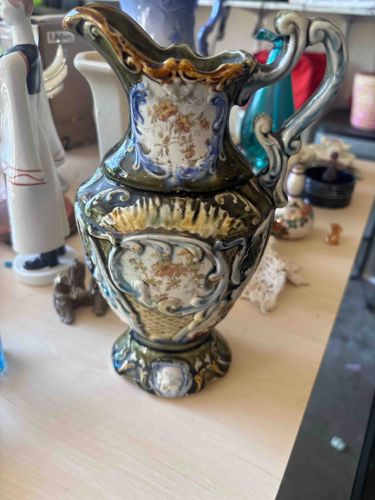
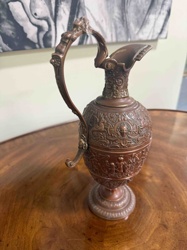
This is an antique ceramic ewer or jug, likely made of majolica or a similar glazed earthenware, given its vibrant, rich colors and relief decoration. The item stands on a flared, round foot and features a robust, ornate handle that curves gracefully from the rim to the upper body. The main body of the ewer is ovoid, tapering to a narrower neck and an open spout with a pinch or pour lip. The color palette is predominantly dark green and brown, with accents of blue, gold/ochre, and off-white/cream. The surface is heavily adorned with applied or molded relief work, presenting an intricate design. The neck and upper body feature a large cartouche on the front, rendered in off-white with delicate floral sprays in muted orange, yellow, and green tones, framed by blue and gold scrollwork. Similar, smaller cartouches appear on the lower body, also with floral motifs against a textured background. The handle and spout are decorated with complimentary scrollwork and gilded accents. Below the main body, the base exhibits a textured, scale-like pattern in a lighter green, transitioning to a dark green foot with more applied relief details, including what appears to be a small, stylized human face or grotesque mask in a light color at the front of the foot. The glaze appears thick and somewhat uneven, characteristic of older ceramic glazes, and there is visible crazing and some loss of detail from wear, particularly on raised areas. The overall impression is one of elaborate, decorative craftsmanship, indicative of a Victorian-era or late 19th to early 20th-century aesthetic, possibly influenced by Renaissance revival or Rococo styles. No visible manufacturer's marks or signatures are discernible from the provided images, but the robust form and decorative complexity suggest a factory production rather than a purely artisanal piece. The condition shows age-appropriate wear and some loss of paint or glaze details, consistent with an antique item that has been handled over time.
AI Appraisal Report
Upon examining the provided image and description of this ornate ceramic ewer/jug, I can offer a preliminary appraisal. The piece presents as a fine example of late 19th-century Majolica, likely of European origin, possibly English, French, or Austrian. The design, featuring intricate relief work, classical cartouches, and a grotesque mask on the foot, is characteristic of the Renaissance Revival style popular during the Victorian era. The vibrant glazes, particularly the rich green and brown ground with cobalt blue and ochre accents, are consistent with high-quality Majolica production of the period. The visible crazing and minor wear to the glaze and gilded highlights are commensurate with its age and do not significantly detract from its decorative appeal; in fact, they help to confirm its antique status. The primary factor limiting its value is the absence of a discernible maker's mark. Pieces by renowned factories such as Minton, George Jones, or Wedgwood command premium prices. Without a mark, the ewer is valued as a decorative example of its type and period. The market for high-quality, unmarked Majolica remains steady, driven by interior designers and collectors of Victorian decorative arts. For a definitive valuation and authentication, a physical examination would be necessary to inspect for hidden marks, assess the clay body, and check for any repairs not visible in photographs. Spectrographic analysis could potentially help identify the glaze composition and link it to a specific manufactory.