AI estimate as of September 1, 2025 · verify with a professional before acting
AI-Generated · Verify before acting
Everything on this page is generated by AI for informational purposes only. AI can make mistakes — the AI may misidentify items or misattribute them (artist, maker, brand, designer, origin, era). This is not an official valuation and should not be used for insurance, sale, tax, estate, legal, or lending purposes — or any decision requiring a certified appraisal. It is not an authoritative claim about any person, brand, or rights holder — do not share or rely on it as a factual statement about a third party. Always consult qualified professionals before making financial decisions.
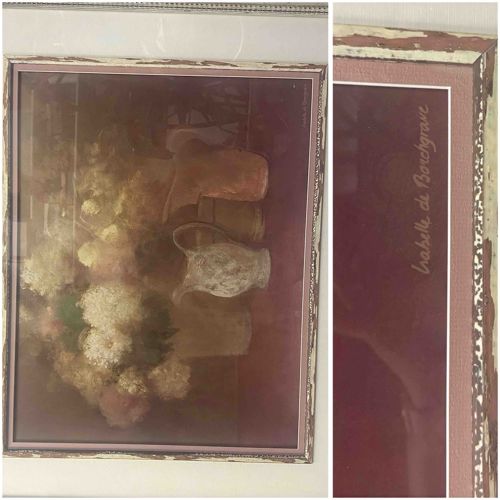
This item is a framed fine art print, likely a giclée or similarly high-quality reproduction, depicting a still life composition. The central image features a lush bouquet of light-colored flowers, possibly hydrangeas or similar blossoms, with visible texture and soft, blended hues suggesting a painterly technique. To the right of the flowers, two pitchers or vessels are visible, one appearing to be ceramic with a distressed, whitewashed finish, and the other, partially obscured, a warmer, reddish-brown tone. The background is a muted, deep reddish-purple, creating a harmonious and somewhat ethereal aesthetic. The print is housed under glass within a distressed wooden frame. The frame features a multi-layered appearance, with an inner silver-toned filet, followed by a wide, distressed white outer frame. The white layer shows significant chipping and flaking, revealing an underlying reddish-brown color, which contributes to an aged or shabby-chic aesthetic rather than being indicative of damage in the traditional sense, suggesting this distress is intentional. An interior mat board, in a soft rosy or dusty pink color, surrounds the print itself, providing a visual border. A notable feature is the visible signature, rotated 90 degrees clockwise, on the right side of the mat board, which reads 'Isabelle de Borchgrave.' This signature indicates the artist or designer of the work. The overall condition of the print appears good, with no visible fading or degradation behind the glass, although reflections make a precise assessment challenging. The frame's intentional distressed finish is a key characteristic. Given the visible signature and the style, it is likely a relatively contemporary piece, perhaps from the late 20th or early 21st century, reproducing a work by Isabelle de Borchgrave, known for her intricate paper sculptures and designs.
AI Appraisal Report
Based on my visual examination of the provided image, this item is a framed fine art print, likely a giclée or high-quality reproduction, of a still life by Isabelle de Borchgrave. The print itself appears to be in good condition, with no visible fading or degradation behind the glass. The frame features a multi-layered, intentionally distressed finish, with chipping and flaking that contribute to its 'shabby-chic' aesthetic rather than indicating damage. The signature 'Isabelle de Borchgrave' is clearly visible on the mat board, suggesting an authorized reproduction. Isabelle de Borchgrave is primarily known for her paper sculptures and designs, and such prints would likely be mass-produced for decorative purposes. For these types of decorative prints, market value is heavily influenced by aesthetic appeal, framing quality, and the artist's general recognition, rather than rarity. Demand is moderate for decorative art prints of this nature, and they are not considered rare. Factors impacting value include the distressed frame's intentional aesthetic, which may appeal to some buyers while deterring others seeking a pristine look. Comparables for similar decorative prints by recognized designers or artists typically fall within the $100-$300 range in the secondary market. The value is primarily driven by its decorative appeal and the name recognition of de Borchgrave on a mass-produced item. My assessment of authenticity is limited to the visible signature and style. For full authenticity verification, an in-person examination would be needed to inspect the print medium (e.g., giclée vs. offset lithograph), confirm the quality and nature of the signature (printed vs. hand-signed), and to assess the frame's integrity beyond surface appearance. Provenance documentation, such as a certificate of authenticity or purchase records, would also significantly aid in confirming its origin and authorized release.