AI estimate as of October 21, 2025 · verify with a professional before acting
AI-Generated · Verify before acting
Everything on this page is generated by AI for informational purposes only. AI can make mistakes — the AI may misidentify items or misattribute them (artist, maker, brand, designer, origin, era). This is not an official valuation and should not be used for insurance, sale, tax, estate, legal, or lending purposes — or any decision requiring a certified appraisal. It is not an authoritative claim about any person, brand, or rights holder — do not share or rely on it as a factual statement about a third party. Always consult qualified professionals before making financial decisions.
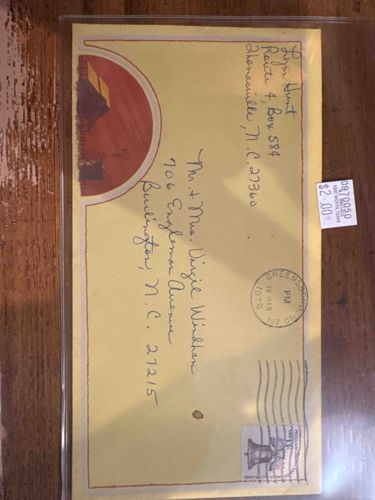
This item is a single, yellow-colored envelope, meticulously addressed in handwritten ink, and presented within a clear protective sleeve, presumably made of plastic or acetate. The envelope measures approximately 9.5 inches in length and 4.125 inches in height, a standard 'number 10' business envelope size. The writing on the envelope is in cursive script and appears to be in dark blue or black ink. The sender's address, 'Lynn Hunt, Route 4, Box 584, Thomasville, N.C. 27360,' is legible in the top left quadrant. The recipient's address, 'Mr. & Mrs. Virgil Windham, 706 Engleman Avenue, Burlington, N.C. 27215,' is prominently centered on the envelope.
A notable decorative element is a printed circular image on the left side of the envelope, featuring a stylized red and yellow geometric design, possibly depicting a landscape or building under a sunset/sunrise, though specific details are difficult to discern without higher resolution. The postage stamp, located in the lower right corner, is a United States Bicentennial issue, specifically showing the Liberty Bell. The stamp is cancelled with a circular postmark that reads 'GREENSBORO, NC, FM, 18 MAR, 1976', indicating the date and location of mailing. The wavy lines of the cancellation further obscure part of the stamp and the envelope below. A small, round, faint brown stain or mark is visible near the center of the envelope, below the recipient's name.
The overall condition of the envelope seems well-preserved, likely due to its protective sleeve. There are no apparent rips, tears, or significant creases on the visible surface, although some minor discoloration consistent with age might be present in areas not obscured by the protective plastic. There is a price tag affixed to the upper right edge of the protective sleeve, indicating '0870050' and '$2.00', suggesting it was previously sold at this price. The item represents a mid-20th-century postal artifact, capturing a moment in time through its postmark and Bicentennial stamp, reflecting the patriotic spirit of 1976.
AI Appraisal Report
I have carefully examined the provided image of this Postmarked Envelope with Bicentennial Stamp. The item presents as a standard 'number 10' business envelope from 1976, featuring a United States Bicentennial Liberty Bell stamp, postmarked in Greensboro, NC. Its condition appears well-preserved, largely due to its protective sleeve, showing no significant tears or creases, with only minor discoloration and a faint stain noted. Authenticity of the envelope and stamp is largely confirmed by the clear postmark date of March 18, 1976, aligning with the Bicentennial stamp issue.
Market conditions for mid-20th century postal artifacts of this nature are generally modest. While the Bicentennial stamp is historically significant, it was widely issued, meaning individual cancelled examples like this are not rare. The specific handwritten address and circular graphic on the envelope do not significantly enhance its value beyond that of a common philatelic cover. Comparables for such covers typically range from a few dollars to perhaps twenty dollars, depending on the stamp, postmark clarity, and specific historical context.
Factors impacting value include the commonality of the stamp and the era, which prevents it from being a high-value item. The protective sleeve is beneficial for preservation but does not increase intrinsic value. The old price tag of $2.00 suggests its prior market valuation. Demand for such items is primarily from collectors focusing on Bicentennial memorabilia or North Carolina postal history.
Limitations in authenticity verification from images alone include the inability to physically inspect the paper quality, ink analysis, or detect any repairs or alterations that might be hidden by the protective sleeve. Full authentication of the stamp itself would involve examining gum condition (if unmounted), perforation details, and watermark (if applicable), which are not visible here. Given its age and commonality, extensive scientific testing or provenance documentation would generally not be economically justified for an item in this price range.