AI estimate as of August 17, 2025 · verify with a professional before acting
AI-Generated · Verify before acting
Everything on this page is generated by AI for informational purposes only. AI can make mistakes — the AI may misidentify items or misattribute them (artist, maker, brand, designer, origin, era). This is not an official valuation and should not be used for insurance, sale, tax, estate, legal, or lending purposes — or any decision requiring a certified appraisal. It is not an authoritative claim about any person, brand, or rights holder — do not share or rely on it as a factual statement about a third party. Always consult qualified professionals before making financial decisions.
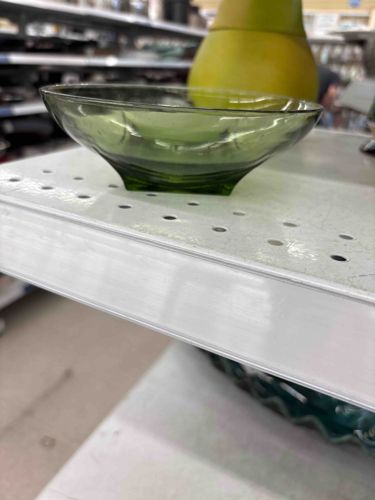
The item is a small, shallow vintage glass bowl, likely a nut or candy dish, crafted from a translucent sage green glass. Its form is somewhat unusual for standard bowls, featuring a gently flared rim and walls that taper inward towards a distinct, squared-off base. The body of the bowl exhibits soft, flowing curvature. There are subtle, almost imperceptible undulations or perhaps a subtle molded pattern on the interior surface, which creates light reflections and adds a tactile element to the design. The construction appears to be machine-made, indicative of mass production. The glass itself is clear with no obvious inclusions or bubbles, suggesting a reasonable level of quality for its time. There are no visible chips, cracks, or significant scratches, indicating good preservation for what appears to be an older piece. The color is a classic mid-century modern green, often referred to as avocado or olive green, suggesting its origin might be from the 1950s to 1970s era. No specific maker's marks or signatures are discernible from the provided image. The design is simple yet elegant, fitting for decorative use or small servings, and reflects the aesthetic tastes of its purported period.
AI Appraisal Report
Upon examining the provided image of the Vintage Sage Green Glass Dish, I assess its condition as excellent. There are no visible chips, cracks, or significant scratches, which is remarkable for a piece likely dating from the mid-20th century. The clarity of the glass and absence of inclusions suggest a good manufacturing quality for its presumed era. Authenticity, based solely on visual cues, points to it being a genuine vintage piece, consistent with mid-century modern glassware, particularly in its color (often called avocado or olive green) and simple yet elegant form. The machine-made appearance aligns with mass production techniques of that period.
Market conditions for vintage glassware, especially in popular mid-century modern colors, remain steady. Comparables for similar small, decorative glass dishes of this era typically fetch between $15 and $40. While the design is aesthetically pleasing, it doesn't present unique features that would elevate its value significantly, such as intricate patterns, known designer attribution, or exceptional rarity. Demand is moderate; these items are sought after by collectors of vintage home decor but are not in high demand as investment pieces. Factors impacting value are primarily its excellent condition and desirable mid-century aesthetic. The lack of discernible maker's marks limits its collectible appeal to brand-specific enthusiasts.
It is crucial to note the limitations of authenticity verification from images alone. A full in-person examination would allow me to physically inspect for subtle flaws, true glass quality, weight, and to search for any faint, unphotographed maker's marks or pontil marks (though unlikely for machine-made items). Provenance documentation, such as original sales receipts or family history, would provide definitive authentication. Scientific testing, like spectroscopic analysis, could confirm glass composition and age but is generally not economically warranted for items in this price range.