AI estimate as of September 1, 2025 · verify with a professional before acting
AI-Generated · Verify before acting
Everything on this page is generated by AI for informational purposes only. AI can make mistakes — the AI may misidentify items or misattribute them (artist, maker, brand, designer, origin, era). This is not an official valuation and should not be used for insurance, sale, tax, estate, legal, or lending purposes — or any decision requiring a certified appraisal. It is not an authoritative claim about any person, brand, or rights holder — do not share or rely on it as a factual statement about a third party. Always consult qualified professionals before making financial decisions.
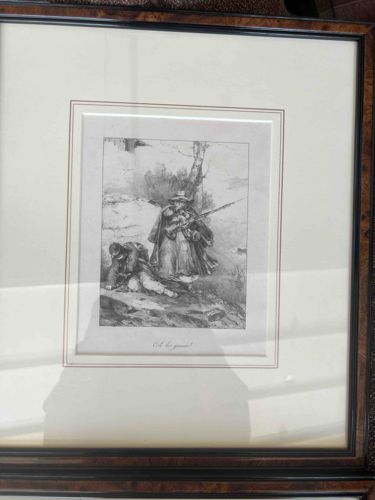
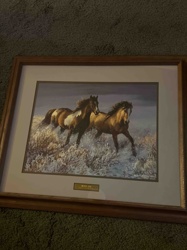
This item is a framed intaglio art print, likely an etching or engraving, depicting a genre scene. The print features two male figures in what appears to be a rustic or outdoor setting. One figure, centrally positioned, is standing and holding a long firearm, possibly a rifle or musket, appearing as a hunter or frontiersman. He is dressed in what looks like a wide-brimmed hat and a voluminous cloak or coat. The second figure is lower to the ground, possibly kneeling or fallen, near the first figure. The overall composition suggests a narrative or dramatic moment. The artwork is rendered in black and white with fine lines and shading, characteristic of intaglio printing techniques. Below the main image, centered, there is text which appears to be a title or caption: 'Oh! les gueux!' which translates from French to 'Oh! the beggars!' or 'Oh! the scoundrels!'. The print itself is matted within a cream-colored matboard, which has a thin double-line border in a darker color, possibly gold or brown, defining the opening for the artwork. This matting is enclosed within a substantial dark wood frame with a rich, possibly burl wood, veneer or finish. The dark, figured wood of the frame provides a strong contrast to the lighter matting and print. Visible condition issues include some reflections on the protective glazing, but the print itself appears well-preserved within its frame, without obvious signs of creasing, tearing, or significant discoloration, considering its likely age. The craftsmanship of the frame and matting appears professional, suggesting a well-maintained piece of framed art. The style hints at 19th-century European art, possibly French, given the caption.
AI Appraisal Report
Based on my visual examination of the provided image, this framed intaglio print, 'Oh! les gueux!', appears to be a well-preserved piece. The print itself exhibits fine detail and shading characteristic of 19th-century etching or engraving, and I see no obvious signs of significant damage such as tears, creases, or major discoloration. The cream-colored matting with its double-line border and the substantial dark wood frame, possibly burl, suggest professional presentation and good care over time. The primary condition issues visible are reflections on the glazing, which do not detract from the print's perceived condition.
Establishing definitive authenticity and precise origins from an image alone is challenging. While the style and French title strongly suggest a 19th-century European, likely French, origin, without a signature, artist's mark, or edition information, it is difficult to attribute this piece to a specific well-known artist. The term 'intaglio print' covers various techniques (etching, engraving, mezzotint); a physical inspection would clarify this. Such prints, if by a lesser-known artist or unattributed, generally fall into the decorative arts market. Market demand for unattributed 19th-century intaglio prints depicting genre scenes is moderate. Comparables often include similar antique framed prints, where value is largely driven by condition, aesthetic appeal, and framing quality rather than solely by artistic provenance.
To fully authenticate, an in-person examination would be crucial to inspect paper type, watermark, printing plate marks, and any hidden signatures or edition numbers. Provenance documentation, if available, would significantly enhance value. Scientific testing for paper aging or ink composition could confirm its temporal origin. Without such deeper investigation, I assess its value primarily as a decorative antique art piece in good condition, well-framed.