AI estimate as of July 30, 2025 · verify with a professional before acting
AI-Generated · Verify before acting
Everything on this page is generated by AI for informational purposes only. AI can make mistakes — the AI may misidentify items or misattribute them (artist, maker, brand, designer, origin, era). This is not an official valuation and should not be used for insurance, sale, tax, estate, legal, or lending purposes — or any decision requiring a certified appraisal. It is not an authoritative claim about any person, brand, or rights holder — do not share or rely on it as a factual statement about a third party. Always consult qualified professionals before making financial decisions.
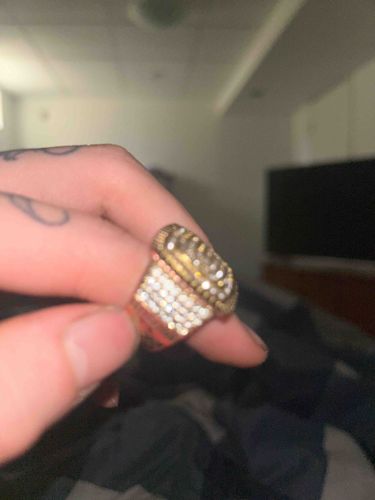
The item is a statement ring, likely crafted from a gold-toned metal, possibly gold-plated or base metal with a brassy finish, given the slightly dull luster visible in some areas. Its most distinctive feature is the pavé-set artificial diamonds or rhinestones that completely cover the top and shoulders of the ring. The top section, which appears to be the primary design element, has an oblong or oval shape with multiple rows of uniformly sized, clear, round faceted stones. The shoulders of the ring are also heavily encrusted with similar stones, arranged in parallel rows, giving it a wide, substantial appearance. Some of the stones appear to be missing or discolored, particularly on the lower left side of the shoulder, suggesting wear or manufacturing imperfections. The overall construction appears robust, indicative of a fashion or costume jewelry piece designed for visual impact rather than inherent material value. The setting for the stones seems to be bead or pavé, aiming to minimize the visibility of the metal between the stones for maximum sparkle. The ring's design suggests a contemporary or modern aesthetic, possibly from the late 20th or early 21st century, designed to mimic high-end diamond jewelry. The craftsmanship, while appearing solid from a distance, shows some irregularities upon closer inspection, especially concerning stone placement and potential adhesive residue. There are no visible maker's marks or stamps in the provided image.
AI Appraisal Report
Based on my visual examination of the provided image, this Gold-Toned Pavé Set Statement Ring presents as a piece of costume or fashion jewelry, rather than fine jewelry. The condition appears to be fair to good, with clear evidence of wear. Specifically, I observe what appear to be missing or discolored stones on the lower left shoulder, which significantly impacts its aesthetic appeal and, consequently, its value. The gold-toned metal, likely brass or a base metal with plating, shows a slightly dull luster consistent with costume jewelry. There are no visible maker's marks or stamps, which is typical for mass-produced fashion items and prevents identification of a specific designer or brand. Authenticity, in this case, refers to whether it is attempting to pass as fine jewelry; it clearly is not, but rather a decorative accessory.
Market conditions for pre-owned costume jewelry are generally low, with value primarily driven by designer provenance, unique artistic merit, or excellent condition. This ring, while visually striking, does not appear to possess the characteristics that would place it in a higher value bracket for costume jewelry. Comparables would include similar pavé-set, gold-toned rings from generic fashion brands, often retailing new for under $50. Demand for such items in the secondary market is limited unless they fulfill a specific stylistic niche or are part of a collectible set.
Factors significantly impacting value negatively include the missing stones, the likely base metal composition, and the absence of any identifiable maker. The lack of precious materials means its intrinsic value is negligible. Rarity is not a factor here; similar designs are widely produced.
Limitations of authenticity verification from images alone are significant. While I can assess the visual characteristics and make an educated estimate of material and construction, I cannot definitively confirm the metal composition (e.g., gold-plated vs. solid gold, or exact stone type without physical inspection). To provide a full authentication and more precise appraisal, an in-person examination would be crucial to test metal purity, verify stone composition (e.g., glass, cubic zirconia, or other synthetics), inspect setting integrity, and search for hidden marks. Microscopic examination could reveal manufacturing techniques and adhesive use, further informing the appraisal. Provenance documentation, if available, could offer insights into its original retail value or designer, but is unlikely for this type of item.