AI estimate as of November 15, 2025 · verify with a professional before acting
AI-Generated · Verify before acting
Everything on this page is generated by AI for informational purposes only. AI can make mistakes — the AI may misidentify items or misattribute them (artist, maker, brand, designer, origin, era). This is not an official valuation and should not be used for insurance, sale, tax, estate, legal, or lending purposes — or any decision requiring a certified appraisal. It is not an authoritative claim about any person, brand, or rights holder — do not share or rely on it as a factual statement about a third party. Always consult qualified professionals before making financial decisions.
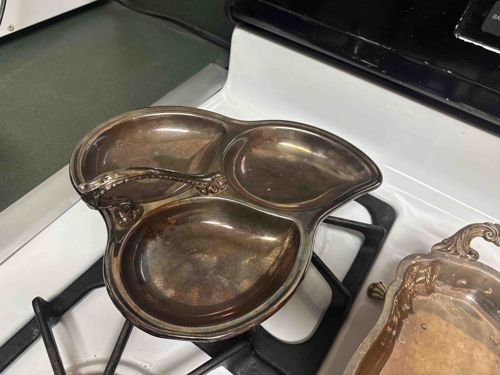
This item is a silver-plated three-compartment relish dish, likely used for serving appetizers, nuts, candies, or condiments. The dish is irregularly shaped, resembling a three-leaf clover or a tri-lobed design, with each compartment smoothly curved and distinct. A small handle, ornately decorated with what appears to be a rococo or Baroque-inspired scrolling foliage motif, connects two of the compartments. The material is a metallic silver-colored alloy with a discernible luster underneath a significant layer of tarnish. The tarnish exhibits a brown to dark brown coloration, particularly heavy in the recessed areas and corners of the compartments, indicating age and lack of recent polishing. There are no visible maker's marks or stamps in the provided image, suggesting potential wear or that they may be located on the underside. The overall craftsmanship appears to be cast metal, with smooth edges and a uniform finish beneath the tarnish. The style points to a mid-20th-century aesthetic, possibly from the 1940s to 1960s, though earlier or later periods are not entirely ruled out without more specific markings. The condition suggests regular use without significant physical damage like dents or cracks, though the severe tarnishing is a primary condition issue that affects its current aesthetic appeal. The presence of such heavy tarnish indicates that the item is indeed silver or silver-plated, as base metals do not tarnish in this manner.
AI Appraisal Report
Upon examining the provided image of this silver-plated three-compartment relish dish, I note its irregular, tri-lobed shape and the rococo/Baroque-inspired scrolling foliage motif on its handle, indicative of a mid-20th-century aesthetic, likely 1940s-1960s. The most striking element of its current condition is the heavy, dark brown tarnish, particularly in recessed areas. This tarnish strongly suggests a silver or silver-plated composition, as base metals tarnish differently. The absence of visible maker's marks is common for items of this nature and era, or they may be on the underside. Physically, the dish appears structurally sound without dents or cracks, which is positive for its overall integrity.
In terms of market conditions, silver-plated relish dishes are generally common. While aesthetically pleasing, they do not command high prices unless they are from a renowned manufacturer, possess exceptional design originality, or are solid silver. The demand for such items is moderate, primarily from collectors of vintage tableware or individuals seeking decorative accents.
Factors significantly impacting value include the lack of a known maker, the commonality of the item type, and most notably, the severe tarnishing. While tarnish confirms plating, it detracts from immediate aesthetic appeal and requires significant cleaning to restore luster. Considering comparable sales for similar unmarked, silver-plated relish dishes, I estimate a value in the range provided.
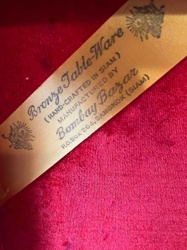
Limitations in authenticity verification are inherent when examining images alone. I can confirm it's likely silver-plated due to tarnish, but I cannot verify the exact metal composition, thickness of plating, or confirm manufacturer without physical inspection for maker's marks (especially on the underside), a closer examination for any hidden damage, or potentially scientific testing for metal content.