AI estimate as of August 17, 2025 · verify with a professional before acting
AI-Generated · Verify before acting
Everything on this page is generated by AI for informational purposes only. AI can make mistakes — the AI may misidentify items or misattribute them (artist, maker, brand, designer, origin, era). This is not an official valuation and should not be used for insurance, sale, tax, estate, legal, or lending purposes — or any decision requiring a certified appraisal. It is not an authoritative claim about any person, brand, or rights holder — do not share or rely on it as a factual statement about a third party. Always consult qualified professionals before making financial decisions.
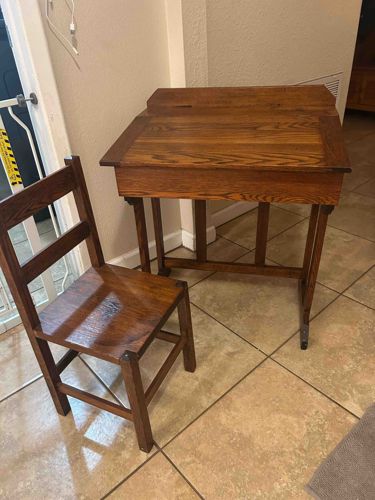
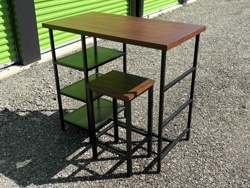
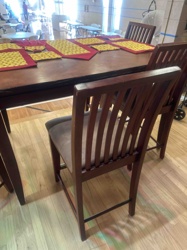
This is a two-piece wooden furniture set, likely constructed from mission or arts and crafts style oak, given the visible graining and robust, simple construction. The set consists of a school desk and a matching chair, both featuring a warm, medium-brown finish with a noticeable sheen, suggesting either a shellac, lacquer, or polyurethane application that has also developed a slight patina. The desk is designed with a sloped writing surface, typical of vintage school desks, and includes a flat top section at the rear. A small, narrow drawer or compartment is visible beneath the main writing surface, extending across the desk's width, which could be for pencils or other small items. The desk stands on four square-profile legs, reinforced by horizontal stretchers connecting the legs on the shorter sides. The chair features a straight, slatted backrest with two horizontal slats and a solid, square seat. Its legs are also of square profile, with stretchers on all four sides for stability, particularly notable on the front where they are slightly raised to meet the bottom of the seat. The joinery appears to be mortise and tenon or sturdy butt joints, indicated by the clean lines and lack of obvious screws or modern fasteners, suggesting quality craftsmanship. There are visible signs of wear consistent with age and use, including scratches, scuffs, and abrasions on both the desk's top surface and the chair's seat and edges, indicating a history of functional use. The condition is good overall, with a desirable aged patina adding to its character without significant damage. No discernible maker's marks or signatures are visible in the provided images, but the style strongly suggests an early 20th-century American manufacture, likely between 1900 and 1930, aligning with the popularity of Arts and Crafts and Mission furniture.
AI Appraisal Report
Upon examining the provided image of this Vintage Oak School Desk and Chair Set, I assess its condition as good, consistent with its likely age and functional history. The visible graining and robust construction strongly suggest a Mission or Arts and Crafts style, typical of early 20th-century American manufacture (circa 1900-1930). The warm, medium-brown finish with a sheen and patina indicates an original or early application. While there are expected signs of wear—scratches, scuffs, and abrasions—these contribute to its character without detracting significantly. The joinery appears sturdy, indicative of quality craftsmanship, with no obvious modern fasteners.
Limitations in authenticity verification exist solely from images. Without physical inspection, I cannot confirm wood type definitively (though oak is highly probable), specific joinery methods (e.g., precise mortise and tenon details), or the exact nature of the finish. In-person examination would allow for tactile inspection of stability, a thorough search for maker's marks, and assessment of internal structures like the drawer mechanism. Provenance documentation, if available, would significantly enhance authenticity. Scientific testing, such as wood analysis or finish dating, could pinpoint precise origins.
Market conditions for vintage educational furniture, particularly in Arts and Crafts styles, remain stable. There is a consistent demand for unique, functional pieces with historical charm. This set's appealing patina and cohesive design make it desirable for residential use as a decorative or functional accent. Comparables typically range, with similar, well-preserved pieces fetching higher values. The absence of maker's marks limits its value from a collector's standpoint seeking branded pieces but does not diminish its inherent aesthetic or utilitarian appeal.
Factors impacting value include its good condition, appealing aesthetic, and the general demand for vintage, well-built furniture. The lack of documented provenance or clear maker's marks is the primary limiting factor in achieving a higher premium. Rarity is moderate; while many school desks were produced, finding a matching chair in good condition adds to its appeal.