AI estimate as of October 10, 2025 · verify with a professional before acting
AI-Generated · Verify before acting
Everything on this page is generated by AI for informational purposes only. AI can make mistakes — the AI may misidentify items or misattribute them (artist, maker, brand, designer, origin, era). This is not an official valuation and should not be used for insurance, sale, tax, estate, legal, or lending purposes — or any decision requiring a certified appraisal. It is not an authoritative claim about any person, brand, or rights holder — do not share or rely on it as a factual statement about a third party. Always consult qualified professionals before making financial decisions.
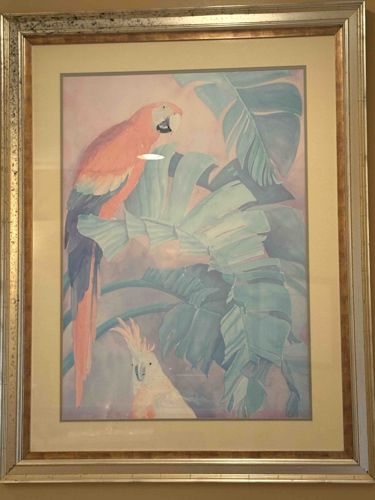
This item is a framed watercolor painting depicting two tropical birds amidst lush foliage. The dominant bird, positioned in the upper left quadrant, appears to be a macaw or large parrot, rendered primarily in shades of salmon pink and light orange for its body and head, with deeper blue and purple tones for its wing and tail feathers. Its beak is open, suggesting a call or vocalization. Partially obscured in the lower center, a smaller, light-colored bird, likely a cockatoo due to its prominent crest, peeks through the leaves. The background is composed of large, broad leaves in various hues of muted blue-green and teal, indicative of tropical plants like banana or palm leaves. The overall color palette is pastel and subdued, with soft transitions between colors, characteristic of watercolor technique. The painting is housed within a multi-layered frame. The innermost layer is a cream or very pale yellow mat board, which creates a significant border around the artwork. The frame itself is a classical style, appearing to be made of wood with a silver-gold finish that shows some distressing or faux antiquing, particularly visible in the corners where darker specks suggest wear or intentional patina. The outer edge of the frame features a ridged or reeded texture, while the inner edge has a smoother, slightly raised profile. The painting is protected by glass, which causes some glare in the provided images, particularly over the macaw's body. No artist's signature or specific manufacturing details are discernible from the image. The style suggests a decorative piece, likely from the late 20th or early 21st century, designed to complement a light and airy interior decor scheme. The craftsmanship of the painting appears competent, with a clear understanding of form and color, though specific details on paper quality or paint vibrancy are difficult to assess without closer inspection. The frame shows minor surface wear consistent with age and handling.
AI Appraisal Report
Based on my visual examination of the provided image of the 'Tropical Birds and Foliage Watercolor Painting,' I assess its condition as good, exhibiting minor surface wear on the frame consistent with age and handling. The watercolor itself appears well-preserved under glass, with colors that seem unfaded from what can be discerned. The artistry is competent, demonstrating a good grasp of watercolor technique, form, and color. However, authenticity cannot be fully verified from images alone. There is no discernible artist's signature or specific manufacturing mark visible, which limits the ability to attribute it to a specific artist or studio. Without physical inspection, I cannot comment on the quality of the paper, the specific pigments used, or the exact vibrancy of the colors. In-person examination would be crucial to assess the true condition of the paper, any potential unseen damage, and to search for very subtle artist's marks or annotations. Provenance documentation, if available, would be essential for establishing authenticity and history.
Considering current market conditions for decorative art and un-attributed watercolors, comparable pieces of similar size and subject matter typically sell within the $100-$300 range. The subject matter – tropical birds – is perennially popular, contributing to a steady demand from individuals looking for decorative pieces that evoke a light, airy, or tropical aesthetic. However, the lack of artist attribution significantly impacts value, preventing it from reaching higher price points reserved for named artists. The framed presentation is attractive, and the classical frame style adds to its decorative appeal, but also adds to the cost of acquisition for a buyer. This appears to be a decorative piece, likely produced in the late 20th or early 21st century, rather than a fine art investment piece. Its value is predominantly decorative and dependent on aesthetic appeal to a broad market, rather than scarcity or artistic significance.