AI estimate as of September 28, 2025 · verify with a professional before acting
AI-Generated · Verify before acting
Everything on this page is generated by AI for informational purposes only. AI can make mistakes — the AI may misidentify items or misattribute them (artist, maker, brand, designer, origin, era). This is not an official valuation and should not be used for insurance, sale, tax, estate, legal, or lending purposes — or any decision requiring a certified appraisal. It is not an authoritative claim about any person, brand, or rights holder — do not share or rely on it as a factual statement about a third party. Always consult qualified professionals before making financial decisions.
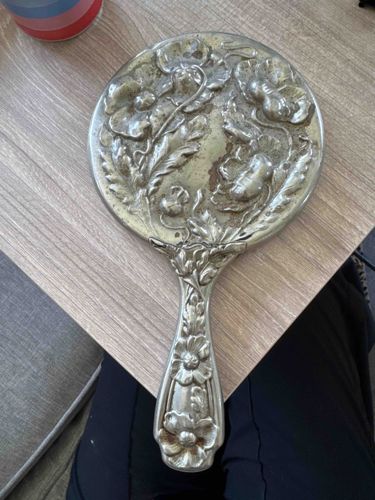
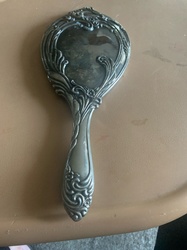
This is a vintage or antique hand mirror, characterized by its elaborate Art Nouveau design. The mirror features a predominantly silver-toned metal, likely silver-plated or a base metal alloy, exhibiting a rich, aged patina with areas of tarnish and discoloration, particularly in the recesses of the relief work. The main body of the mirror, which is circular or oval-shaped, is extensively decorated on its reverse side with high-relief floral motifs. These flowers appear to be poppies or a similar large-petaled bloom, intertwined with leaves and swirling organic lines typical of the Art Nouveau style. The craftsmanship suggests a cast or repoussé technique, giving the floral elements a pronounced three-dimensional quality. The handle seamlessly integrates with the mirror's frame, also featuring complementary floral and foliate designs in relief. The handle itself has a bulbous end, tapering towards the mirror head, making it comfortable to hold. There are visible signs of wear consistent with its age, including surface scratches and general dulling of the metal finish. Some deeper recesses show a darker accumulation, indicating years of exposure and lack of rigorous cleaning. There are no readily visible maker's marks or signatures from the provided images, which might be on the edge or the frame of the actual mirrored surface (not visible here). The style points strongly to the late 19th or early 20th century, specifically the Art Nouveau period (roughly 1890-1910s), given its organic forms and flowing lines. The overall quality of the casting and detail work suggests a commercially produced item of good to high standard for its era.
AI Appraisal Report
Based on my visual examination of the provided image, this Art Nouveau ornate hand mirror presents as an authentic piece from the late 19th to early 20th century. The organic, flowing lines, detailed floral motifs, and overall design are highly characteristic of the Art Nouveau period (1890-1910s). Its condition shows significant age-appropriate wear, including tarnish, discoloration, and surface scratches, all consistent with decades of use and exposure. The high-relief casting quality is good, indicating a commercially produced item of respectable craftsmanship for its era.
Market conditions for vintage Art Nouveau vanity items are generally stable, with a strong demand for well-preserved, aesthetically pleasing examples. However, this piece, while appealing, is not exceptionally rare. Comparables, typically found in antique shops or online marketplaces, show a range in value depending on material (e.g., sterling silver versus plated metal), condition, and provenance. Without visible maker's marks, determining a prominent manufacturer is impossible from the image alone, which can limit its top-tier market appeal.
The primary factors impacting its value are the appealing Art Nouveau design and its relatively good structural integrity despite the surface wear. The lack of visible maker's marks and the uncertainty regarding the exact metal composition (likely silver-plated or base metal) prevent a higher valuation.
Limitations in authenticity verification from images alone are significant. While the style strongly points to Art Nouveau, definitive authentication regarding material composition, precise dating, and identification of a specific maker would require a physical examination to check for hallmarks, perform metal testing, and assess the mirror's true surface condition. Thorough provenance documentation would also enhance its value and confirm its history.