AI estimate as of November 15, 2025 · verify with a professional before acting
AI-Generated · Verify before acting
Everything on this page is generated by AI for informational purposes only. AI can make mistakes — the AI may misidentify items or misattribute them (artist, maker, brand, designer, origin, era). This is not an official valuation and should not be used for insurance, sale, tax, estate, legal, or lending purposes — or any decision requiring a certified appraisal. It is not an authoritative claim about any person, brand, or rights holder — do not share or rely on it as a factual statement about a third party. Always consult qualified professionals before making financial decisions.
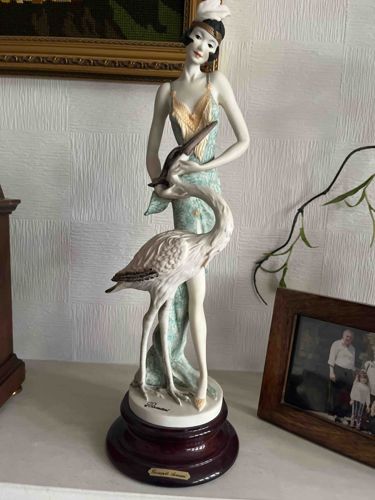
This appears to be a Capodimonte-style porcelain figurine depicting a graceful woman interacting with a heron. The figurine is composed of glazed porcelain, showcasing a delicate color palette that includes pale skin tones for the woman, a light teal or mint green for her flowing dress with subtle gold or cream accents, and naturalistic white and light brown tones for the heron. The woman is stylized with a classic flapper-era aesthetic, featuring a headpiece or headband with what appears to be a white feather or plume, and a bobbed hairstyle under the headband. Her facial features are delicately painted with dark eyes, defined eyebrows, and subtle red lips. She wears a sleeveless, somewhat sheer-looking dress with spaghetti straps and a v-neckline, which drapes elegantly around her legs. Her left arm cradles the neck of a tall heron, whose long legs are positioned close to hers, suggesting an intimate connection between the two figures. The bird itself exhibits fine textural details to imply feathers. Both figures stand on a round white porcelain base, which in turn is mounted on a larger, dark stained wooden plinth. This wooden base has a polished finish and a brass-colored metal plaque on its front, which appears to have an inscription, though it is not fully legible. The overall craftsmanship suggests a high level of detail, typical of artisanal porcelain figures. There are no visible signs of significant damage such as chips, cracks, or repairs, and the glaze appears intact, indicating good preservation. The style points to a potential Art Deco influence given the woman's attire and makeup, placing its estimated age possibly in the mid-to-late 20th century, though Capodimonte-style pieces are still produced today. The base includes a signature or maker's mark 'C.P. Armani' or similar on the white porcelain pedestal, which is a key identifying feature for these types of collectibles.
AI Appraisal Report
Based on my visual examination of the provided image, this Capodimonte-style figurine, 'Lady with Heron,' appears to be in very good condition. The glazed porcelain shows no immediate signs of chips, cracks, or repairs, and the intricate details and delicate color palette are well-preserved. The subtle gold or cream accents are intact, and the facial features are finely painted. The presence of a signature or maker's mark, identified as 'C.P. Armani' or similar on the white porcelain pedestal, is a crucial indicator. Assuming this mark is authentic, it points to a piece by Giuseppe Armani, a renowned Italian sculptor known for his Capodimonte-style creations. His figurines often feature a high level of detail and are highly collectible.
Market conditions for Armani figurines are steady, with demand sustained by collectors who appreciate their detailed craftsmanship and aesthetic appeal. Pieces depicting women with animals, especially in elegant, stylized forms, tend to perform well. Comparisons with similar Armani figurines available through online marketplaces and auction records suggest this piece falls within a mid-range value for his work. The overall excellent condition significantly enhances its marketability. The Art Deco influence in the woman's attire and styling further adds to its appeal, potentially attracting a broader collector base.
However, it's important to note the limitations of an appraisal based solely on images. While the 'C.P. Armani' mark is a strong indicator, full authentication would require an in-person examination to verify the mark's legitimacy, assess the quality of the porcelain and glaze up close, and confirm the absence of any subtle damages or restorations not visible in photographs. Provenance documentation, such as original purchase receipts or certificates of authenticity, would further solidify its value and authenticity. Without this, I cannot definitively confirm its full authenticity as a Giuseppe Armani original, but the visual evidence strongly suggests it.