AI estimate as of October 12, 2025 · verify with a professional before acting
AI-Generated · Verify before acting
Everything on this page is generated by AI for informational purposes only. AI can make mistakes — the AI may misidentify items or misattribute them (artist, maker, brand, designer, origin, era). This is not an official valuation and should not be used for insurance, sale, tax, estate, legal, or lending purposes — or any decision requiring a certified appraisal. It is not an authoritative claim about any person, brand, or rights holder — do not share or rely on it as a factual statement about a third party. Always consult qualified professionals before making financial decisions.
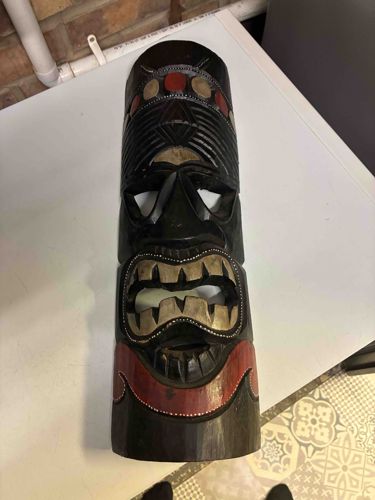
This is a vertically oriented, carved wooden mask, possibly representing a tiki or a similar tribal deity or figure. The mask is predominantly dark brown or black in color, suggesting a stained or painted finish on a naturally light-colored wood. It features distinct facial elements including prominent brow ridges, deeply set, hollowed-out eyes creating a formidable gaze, and a large, open mouth displaying a formidable set of teeth. The teeth are painted in an off-white or light beige color, contrasting sharply with the dark wood of the face. The upper part of the mask, above the eyes, is adorned with a decorative band featuring alternating red and light beige circular elements, possibly made from inlaid shells or painted wood, bordered by small, dotted patterns in white. Below the mouth, there is a curved, reddish-brown band, also outlined with similar white dot patterns, adding to its decorative appeal. The surface of the mask has carved lines and textures, particularly visible on the forehead and around the mouth, contributing to its artistic depth. The overall construction appears solid, carved from a single piece or multiple pieces joined seamlessly. The finish shows some minor wear and slight variations in color, consistent with age or handmade production, but appears to be in good overall condition with no obvious signs of significant damage like cracks or chips from the visible areas. The craftsmanship suggests it is a decorative piece, likely intended for wall hanging, embodying a tribal or Polynesian art style. The estimated age is likely contemporary, rather than ancient, possibly from the late 20th or early 21st century.
AI Appraisal Report
Based on my visual examination of the provided image, I assess this Tiki-Style Carved Wooden Mask to be in good overall condition. There are no readily apparent signs of significant damage such as large cracks or chips from what I can see. The finish appears consistent with a stained or painted piece. Authenticity, based solely on this image, points to it being a decorative item rather than an ancient or culturally significant artifact. The style, detailing, and finish suggest modern craftsmanship, likely from the late 20th or early 21st century, designed for decorative rather than ceremonial purposes.
Market conditions for such contemporary, decorative Tiki-style masks are generally modest. Comparables often include mass-produced or artisan-made carvings sold in gift shops, home decor stores, or online marketplaces. While the carving shows reasonable detail and effort, it does not possess the rarity or historical significance that would command higher values. Demand is present but limited to those seeking themed decor, and there isn't a strong collector's market for this type of contemporary piece.
Factors impacting its value include its decorative appeal, lack of significant damage, and the perceived quality of craftsmanship. However, its contemporary origin, lack of cultural provenance, and likely mass-produced or semi-mass-produced nature significantly limit its ceiling. For full authentication and a more precise valuation, I would require a physical inspection to assess the type of wood, carving techniques, and any artist signatures or maker's marks, which are not discernible from the image. Provenance documentation, if available, would also be crucial, though unlikely for an item of this type. Scientific testing, such as carbon dating, would be impractical and unnecessary given its apparent contemporary age.