AI estimate as of July 6, 2025 · verify with a professional before acting
AI-Generated · Verify before acting
Everything on this page is generated by AI for informational purposes only. AI can make mistakes — the AI may misidentify items or misattribute them (artist, maker, brand, designer, origin, era). This is not an official valuation and should not be used for insurance, sale, tax, estate, legal, or lending purposes — or any decision requiring a certified appraisal. It is not an authoritative claim about any person, brand, or rights holder — do not share or rely on it as a factual statement about a third party. Always consult qualified professionals before making financial decisions.
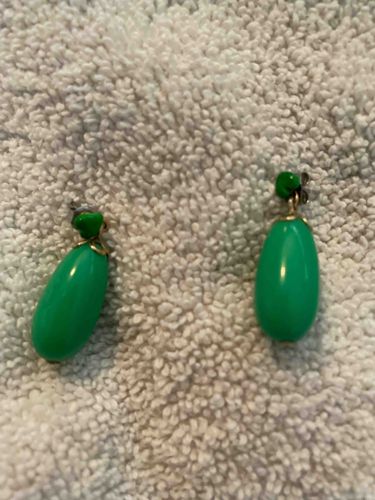
The item consists of a pair of vintage-style drop earrings, each featuring a vibrant, opaque green tear-drop or olive-shaped fob suspended from a smaller, round green bead. The main body of each earring is smoothly polished and appears to be made of a rigid material, possibly a form of plastic, Bakelite, or a synthetic resin, given its uniform color and lack of natural inclusions typically found in gemstones. The color is a consistent, bright emerald green, suggesting a dyed or manufactured material rather than a natural stone like jade, which often exhibits variations in translucency and veining. The fobs are securely attached to the smaller round beads, which in turn are connected to what appears to be a metal finding at the top, likely for a hook or clip-on mechanism, though the exact attachment type is not clearly visible. The metal findings appear to be a yellow-toned metal, possibly gold-plated or brass, showing a slight darkening or patina consistent with age or wear. There are no obvious signs of significant damage such as chips, cracks, or deep scratches on the green elements, suggesting they are in good overall vintage condition. The craftsmanship appears to be commercial grade, common for costume jewelry of the mid-20th century. No maker's marks or distinguishing signatures are visible in the provided image. These earrings likely date from the mid-20th century, possibly 1950s-1970s, based on their design aesthetic and material appearance.
AI Appraisal Report
Upon visual examination of the provided image, these Vintage Green Drop Earrings appear to be in good overall vintage condition. The green elements show no obvious chips, cracks, or deep scratches, maintaining their smooth, polished appearance. Authenticity, based solely on the image, suggests these are indeed vintage costume jewelry. The uniform, opaque emerald green color and the smooth finish are highly indicative of a manufactured material like Bakelite, plastic, or synthetic resin, rather than natural gemstones. The yellow-toned metal findings, showing some patina, further support their vintage nature.
From a market perspective, comparable vintage costume jewelry earrings of this style and material typically achieve modest prices. Demand for such pieces is generally stable within the vintage and costume jewelry collector communities. These items are not rare; similar designs from the mid-20th century were mass-produced. The primary factors impacting value are the material (which is not precious), the absence of designer marks, and their common design.
Limitations in authenticity verification from images alone are significant. While the material appears to be synthetic, a definitive identification (e.g., confirming Bakelite versus another early plastic) requires in-person examination, including tactile tests (e.g., rubbing to detect formaldehyde scent for Bakelite) and specific gravity testing. Provenance documentation, such as original sales receipts or family history, would also strengthen authentication and potentially add to collector interest, though it would likely not drastically alter the value for an unmarked costume piece. Scientific testing would be necessary for precise material identification if required.