These notes were written by the person who submitted this item. Appraiser.AI has not verified them, and the AI's identification and estimate may rely on them.
AI Estimated Value
Not an official valuation
$250-400
AI estimate as of October 15, 2025 · verify with a professional before acting
AI-Generated · Verify before acting
Everything on this page is generated by AI for informational purposes only. AI can make mistakes — the AI may misidentify items or misattribute them (artist, maker, brand, designer, origin, era). This is not an official valuation and should not be used for insurance, sale, tax, estate, legal, or lending purposes — or any decision requiring a certified appraisal. It is not an authoritative claim about any person, brand, or rights holder — do not share or rely on it as a factual statement about a third party. Always consult qualified professionals before making financial decisions.
This analysis also relies on unverified notes provided by the user, which may be incomplete or inaccurate and could affect the result.
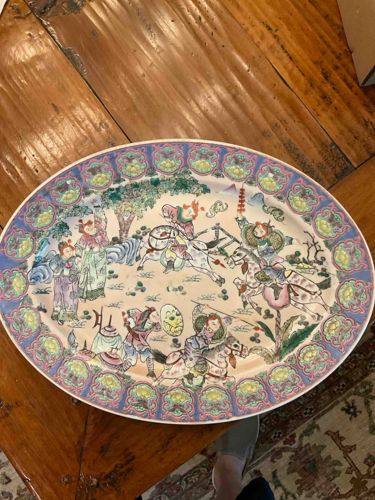
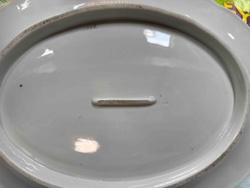
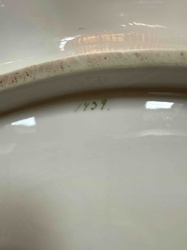
This is an oval-shaped porcelain platter, approximately 12 inches by 6 inches, featuring an intricate and vibrant equestrian battle or procession scene. The central motif depicts several figures on horseback, engaged in dynamic poses, suggesting a historical or mythological narrative. The color palette is rich and diverse, typical of Imari or Kutani porcelain, including shades of green, pink, blue, yellow, and reddish-orange on an off-white or cream background. Details such as facial features, clothing, and horse trappings are finely rendered, indicating a good level of craftsmanship. One figure appears to be holding a shield, while others wield spears or similar weapons. In the background, there are elements of traditional landscape, including stylized trees and cloud formations. The rim of the platter is adorned with a recurring border pattern featuring floral or ruyi-scepter motifs, primarily in blue, pink, and light green, giving it a distinct decorative edge. The overall condition appears to be good, with no immediately visible chips, cracks, or significant losses to the glaze or paint, though a closer inspection would be needed to confirm this. There are no discernible maker's marks or signatures visible in the provided image. Based on the style and decorative elements, it strongly suggests a Japanese origin, likely an Imari or Kutani-style piece, possibly dating from the late 19th to mid-20th century. The hand-painted details and complex composition point to a quality piece of decorative porcelain.
AI Appraisal Report
Based on my examination of the provided image, this Japanese Imari-style porcelain platter, measuring approximately 12x6 inches, presents as a charming and decorative piece. The vibrant color palette, including green, pink, blue, yellow, and reddish-orange on an off-white ground, is characteristic of Imari or Kutani ware. The equestrian scene, depicting figures in historical or mythological context, shows a good level of craftsmanship in the fine rendering of details like facial features, clothing, and weaponry. The border, with its floral or ruyi-scepter motifs, further enhances its decorative appeal.
The condition appears good, with no evident chips, cracks, or significant paint loss from the image. However, a thorough physical inspection is crucial to confirm this; hidden hairline cracks, repairs, or glaze imperfections are not discernible via photograph alone. Authenticity is challenging to definitively verify from images; while consistent with late 19th to mid-20th century Japanese decorative porcelain, the absence of a maker's mark limits precise attribution. Without provenance documentation or a physical inspection to assess the quality of the porcelain body, the firing, and the specific application of glazes and enamels, it's difficult to confirm origin or exact age beyond stylistic indicators.
Market demand for decorative Japanese porcelain of this period is generally stable but not exceptionally strong for unmarked pieces without significant historical provenance or artistic attribution. Comparable Imari or Kutani-style platters of similar size and decorative complexity, lacking specific artist attribution or pristine condition, typically fall within the $200-$500 range. The intricate hand-painted details are a positive factor, but the lack of a visible signature or mark, combined with the inability to physically assess quality and condition, places it towards the mid-to-lower end of that spectrum. Factors that would significantly increase value include a confirmed prestigious kiln mark, exceptional rarity in subject matter, or documented historical ownership.