AI estimate as of June 27, 2025 · verify with a professional before acting
AI-Generated · Verify before acting
Everything on this page is generated by AI for informational purposes only. AI can make mistakes — the AI may misidentify items or misattribute them (artist, maker, brand, designer, origin, era). This is not an official valuation and should not be used for insurance, sale, tax, estate, legal, or lending purposes — or any decision requiring a certified appraisal. It is not an authoritative claim about any person, brand, or rights holder — do not share or rely on it as a factual statement about a third party. Always consult qualified professionals before making financial decisions.
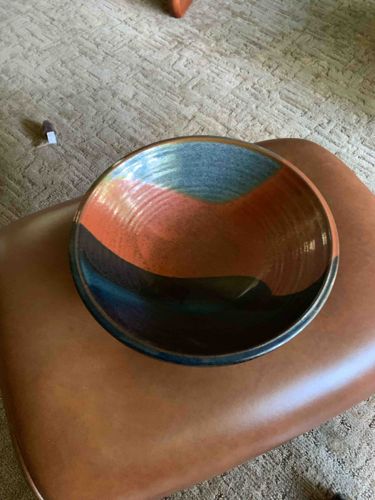
This is a distinctive, substantial round ceramic bowl, likely crafted from stoneware, showcasing a vibrant and abstract tri-color glaze application on its interior surface. The bowl features a sturdy, circular form with a slightly flared rim, indicative of having been hand-thrown on a potter's wheel, as evidenced by the clear concentric ridges visible beneath the glaze, particularly prominent in the reddish-orange section. The interior is masterfully divided into three organic, flowing segments of color: a dominant, earthy reddish-orange hue (reminiscent of terracotta or rust), a calming light blue-grey, and a deep, rich navy or dark teal blue, which transitions almost to black in the lower quadrant. The glazes exhibit a consistent glossy finish, reflecting light well, and appear skillfully applied with smooth, blended transitions between the color zones rather than sharp, defined lines. The exterior of the bowl is not fully visible, but the rim suggests an unglazed, dark, or subtly colored finish that complements the interior. No significant chips, cracks, or visible damage are discernible from the provided image; the glazes appear intact and well-preserved, suggesting good overall condition. While no specific maker's marks or signatures are visible, the artisanal quality points towards studio pottery or individual craftsmanship. The aesthetic, with its organic forms and earthy yet modern color palette, strongly suggests a mid-to-late 20th-century origin (e.g., 1960s-1990s) or a contemporary piece inspired by that era. Its robust construction and unique glazing make it suitable for both decorative display and functional use as a serving piece, highlighting skilled craftsmanship in both form and surface treatment.
AI Appraisal Report
Based on my visual examination of the provided image of this Artisanal Tri-Color Glazed Ceramic Serving Bowl, I assess its condition as excellent. There are no discernible chips, cracks, or significant wear; the glazes appear vibrant, intact, and well-preserved, indicative of careful handling or minimal use. Authenticity, in terms of it being a genuinely hand-crafted studio pottery piece, seems highly plausible given the visible concentric ridges from hand-throwing and the organic nature of the glaze application. It aligns well with characteristics of mid-to-late 20th-century or contemporary artisan ceramics.
The market for unique, well-executed studio pottery remains robust, especially for functional yet decorative pieces like this. This bowl's substantial size, distinctive tri-color glazing, and good condition make it appealing. Comparables would include unmarked studio art pottery bowls of similar size and quality, typically selling in the $200-$500 range, depending on aesthetic appeal and provenance. Demand for artisanal pieces with a unique aesthetic, particularly those versatile for both display and use, is consistent. While not inherently rare as individual pieces, unique artisan works are "one-of-a-kind," contributing to their desirability.
Factors significantly impacting value include its excellent condition, appealing aesthetic, and apparent craftsmanship. The lack of a visible maker's mark or artist signature limits its value considerably compared to attributed works, which might fetch significantly higher prices.
It is crucial to note the limitations of an appraisal based solely on images. Full authentication would require a hands-on examination to confirm integrity, assess true dimensions, weight, and detect any subtle surface imperfections or repairs not visible in photographs. Provenance documentation, if available, clarifying the artist or origin, would be invaluable for definitive authentication and potentially increased valuation. Scientific testing is generally not applied to routine ceramics unless forgery is suspected; here, physical inspection is key.